One label, three different account records
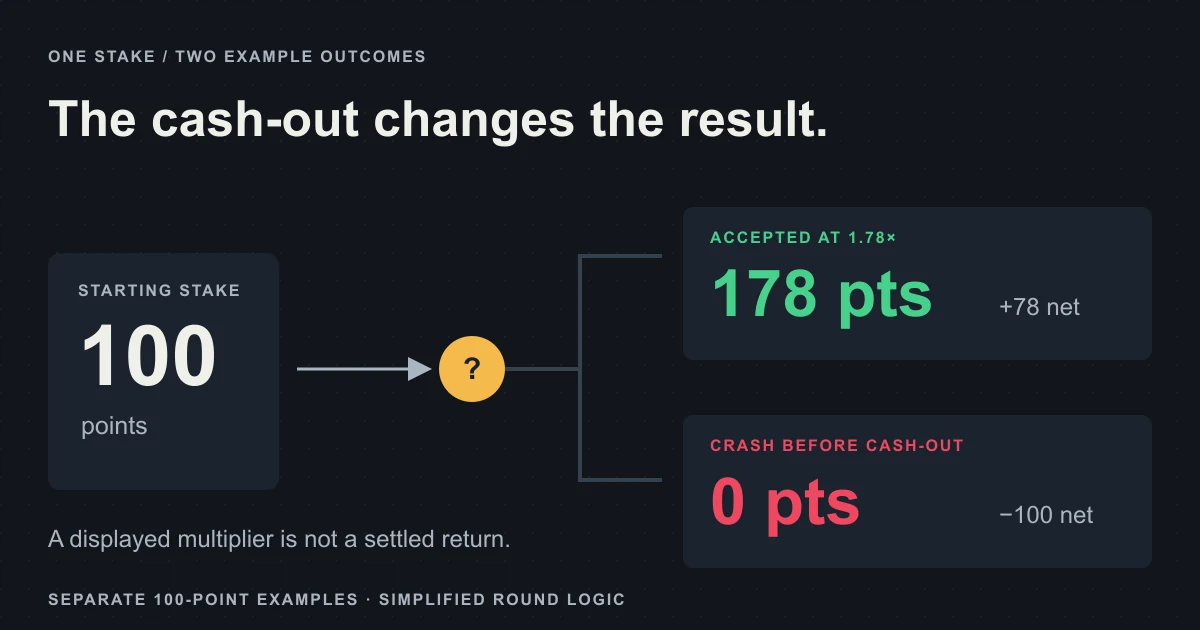
Suppose you selected 100 points before a round whose history later reads 1.00×. Start with the entry status, not a multiplication of 100 by the tile’s number. These hypothetical records produce different outcomes even though the history label is identical.
| Entry record | Recorded return | What the record means |
|---|---|---|
| Accepted; lost before cash-out | 0 | The stake was committed and lost. |
| Rejected before acceptance | No completed stake | There was no accepted entry to settle; check any pending hold. |
| Accepted; later voided and refunded | 100 | A refund restored the stake under a separate status. |
A refund is not a cash-out at 1.00×. A rejected entry is not a completed loss. Keep these distinctions when matching the entry to a wallet movement, particularly when the interface first showed a pending amount.
Two decimals may hide the boundary
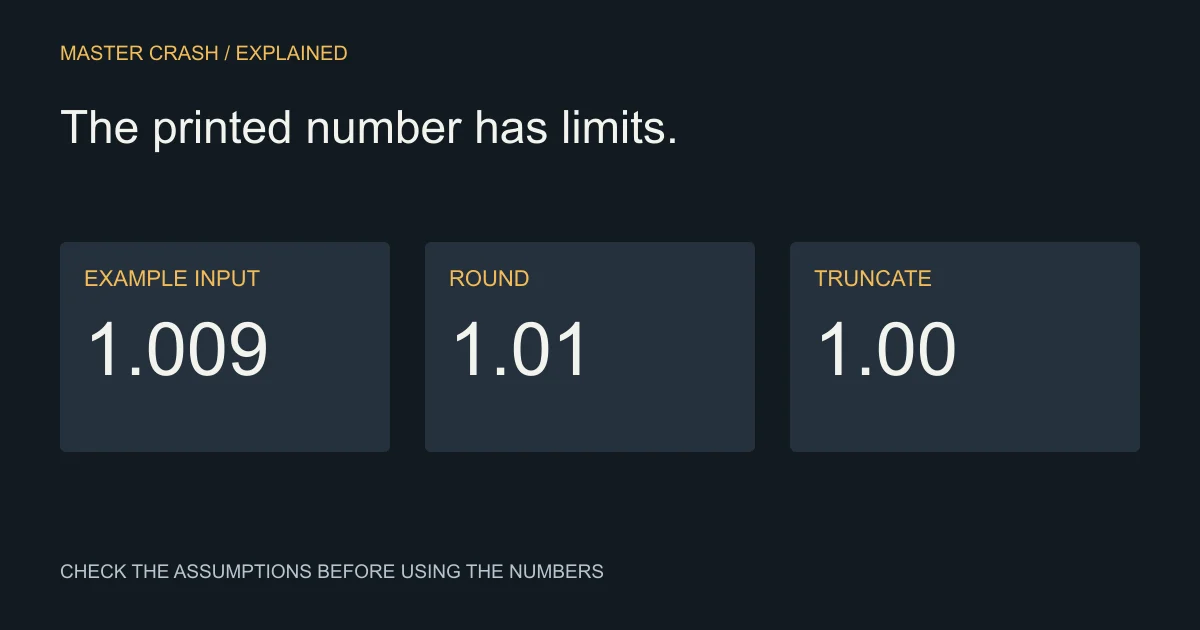
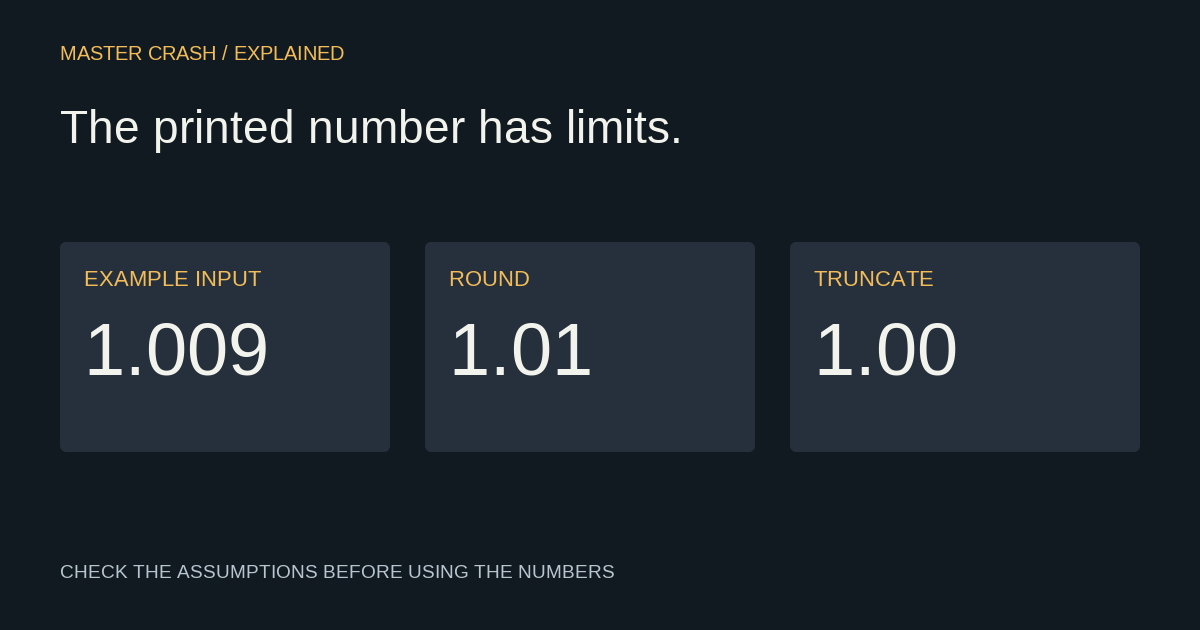
To see why precision matters, take a made-up internal value of 1.004. Rounding to the nearest hundredth displays 1.00. Truncating to two decimals also displays 1.00. A value of 1.009 displays 1.01 under ordinary nearest rounding but 1.00 when truncated.
These examples explain a display ambiguity; they do not describe Master Crash’s implementation. A product may generate an exact 1.00 result, have a separately defined immediate-crash outcome, or transform a value before display. You cannot identify which method was used from two printed decimals.
The same limitation applies at a target such as 2.00×. A displayed crash point and a selected target can look equal while the underlying comparison uses a different precision. Even when values are exactly equal, the product still needs a rule for whether equality counts as success.
Which rules and receipts resolve the question?
Look for four specific items in the product’s own rules: the permitted cash-out range, the precision used for settlement, what happens when a target equals the crash point, and how interrupted or voided rounds are treated. Do not import a different Crash game’s tie rule because the charts look similar.
As a documentation reference, the UK Gambling Commission’s RTS 3 calls for accessible rules and information explaining winning outcomes and payouts for the products within its scope. This is a Great Britain regulatory reference, not a claim that Master Crash holds a British licence or follows a particular boundary rule.
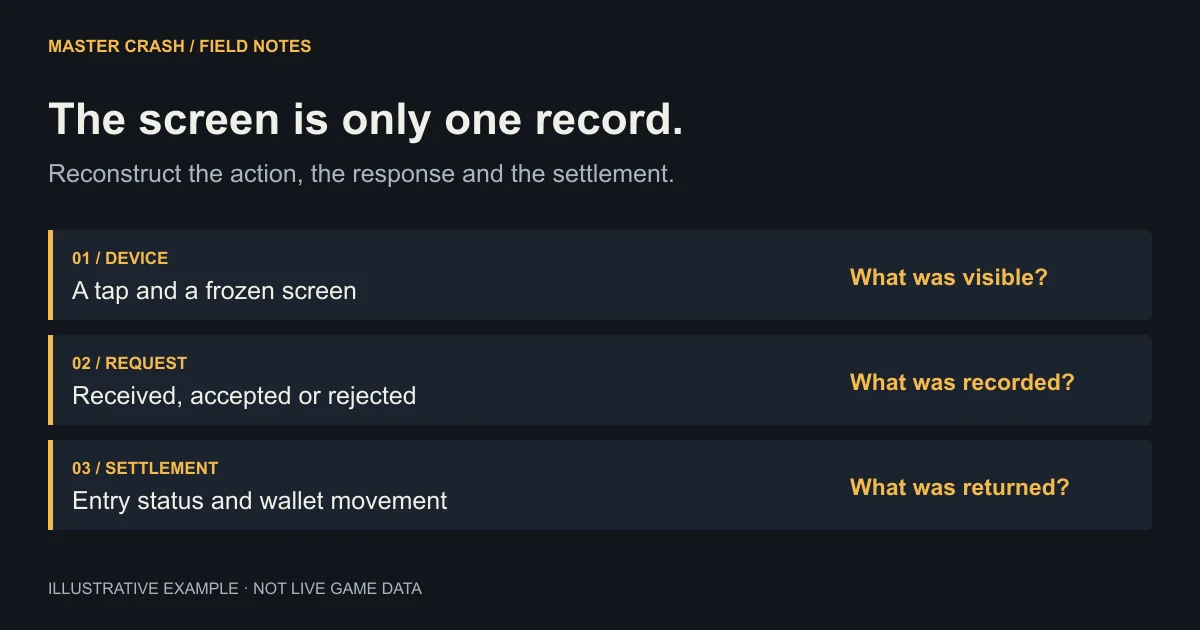
Then compare the rules with the entry receipt. A record containing an accepted cash-out multiplier and returned amount is stronger evidence of that entry’s outcome than the largest number captured in a screenshot. A button tap alone is not the same record; the disconnection evidence guide separates the device action from receipt and settlement.
A useful support note is specific
Write down the round ID, entry ID, displayed crash point, stake, entry status, cash-out acknowledgement if present and final wallet movement. Include the time zone and retain the relevant version of the rules. Redact account identifiers before sharing screenshots publicly.
A concise query might read: “Round R-104 displayed 1.00×. Entry E-27 shows accepted, stake 100, status lost and return 0. Please identify the rule used for this settlement and provide the accepted cash-out record, if any.” The identifiers and amounts here are placeholders, not an actual complaint.
Do not turn the frequency of 1.00× tiles into a prediction for the next round. This article addresses interpretation of a completed record. For calculations across completed entries, use gross return and net change; for a sequence of results, read what a losing streak can establish.
Sources & further reading
Worked examples are illustrative. Operator documentation describes that operator’s product and is not an independent audit of the games discussed here.