Start with five rounds chosen in advance
Use an intentionally simple teaching model: each round independently has a 50% chance of ending below a threshold selected beforehand. This is not a measured Master Crash probability, and it does not imply that any particular real cash-out target has a 50% success rate.
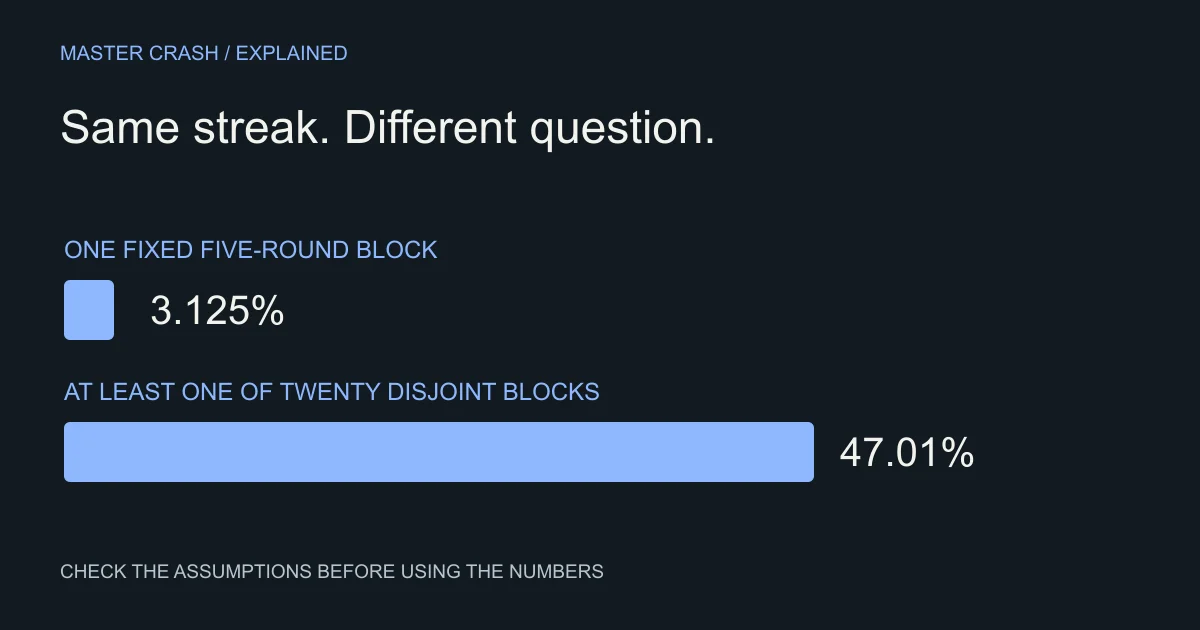
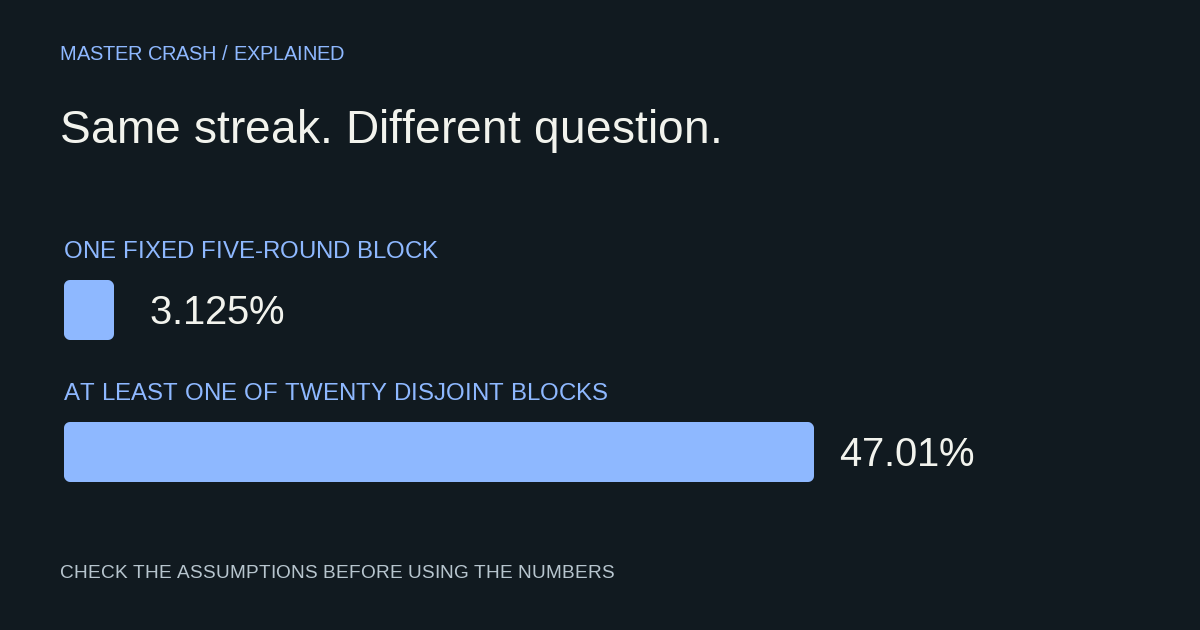
The probability that all five specified rounds are below that threshold is 0.5 × 0.5 × 0.5 × 0.5 × 0.5 = 0.03125, or 3.125%. More generally, if the independent low-result probability is q, the corresponding five-round probability is q⁵.
| Assumed probability per round | Five specified low rounds |
|---|---|
| 40% | 1.024% |
| 50% | 3.125% |
| 60% | 7.776% |
The large change across those rows matters. A calculation that silently assumes 50% cannot be used as a fairness test for a product whose probabilities have not been established.
A long history gives you many places to find a streak
Now examine 100 rounds from the same hypothetical 50% independent model. Divide them into 20 non-overlapping blocks of five. The probability that at least one whole block contains five low results is 1 − (1 − 0.5⁵)²⁰, approximately 47.01%.
This is a lower bound for finding a five-result streak anywhere in the 100 rounds. A run can also cross one of those block boundaries. Counting every overlapping five-round window requires a different calculation because adjacent windows share outcomes; they are not independent trials.
That is why “this specific five-round block was unlikely” does not mean “seeing a streak somewhere in a long record was equally unlikely.” The search process changes the question. Choosing the most dramatic part of a history after viewing it creates many opportunities to find an eye-catching pattern.
The next round is a separate question
Under the independent model, after five low rounds the probability of another low round is still 50%. The probability of six specified low rounds before any of them happen is 1.5625%. Once five have already happened, multiplying their probabilities again answers the wrong question about the sixth.
Independence is an assumption to establish from a product’s documented design, not something a row of tiles proves. The Gambling Commission’s RTS 7 discusses unpredictability, statistical assessment and restrictions on adaptive outcomes for products within its scope. It is a useful reference for the kind of evidence involved, not an audit of Master Crash.
A result that departs from a claimed model can justify further investigation. It does not automatically reveal the cause, and it does not give a profitable next-round signal. A missing record, changed threshold or different product version can also invalidate a comparison.
Make a pattern claim testable
Record the product and rules version, the threshold, the start and end of the observation window, and every result within it. Preserve round IDs so gaps and duplicates can be checked. Decide what you will count before inspecting the history: one fixed block, the longest run, or the number of runs.
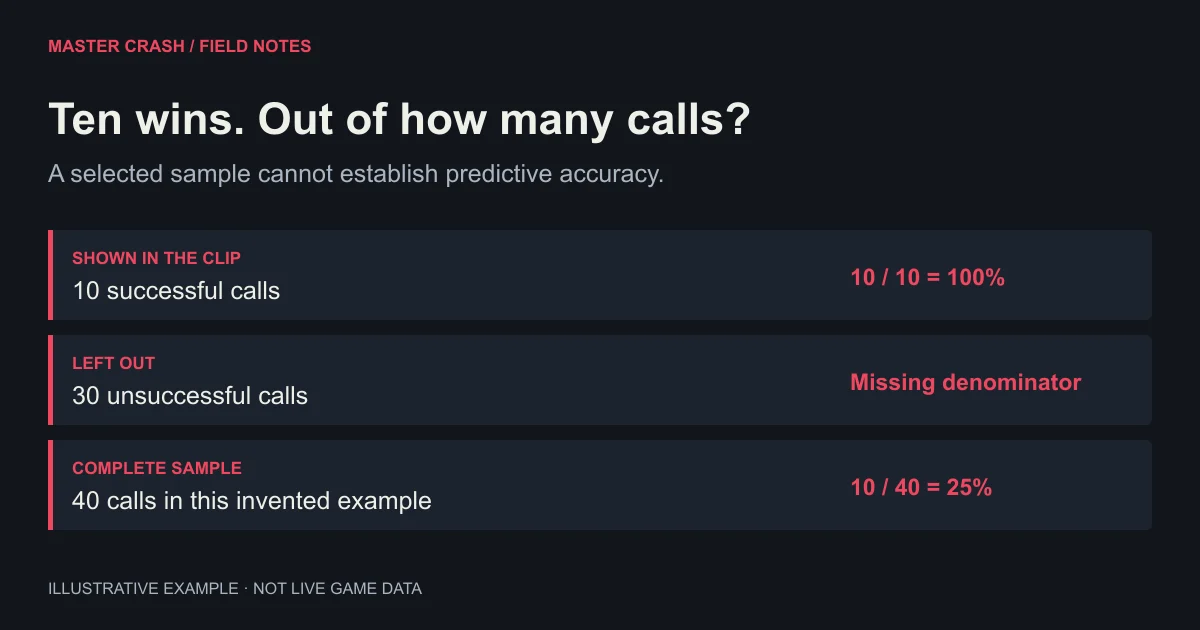
If someone publishes only the five-result crop, ask how many rounds and thresholds they searched. If someone advertises a prediction method, ask for the complete sequence of timestamped calls, including failures. Our predictor evidence article shows how omitted calls change a reported success rate.
The calculations above can be reproduced with ordinary exponentiation. They are original examples using stated assumptions, not a simulation or a sample of live play. Keep the distinction when using the round-history checklist: records can explain a completed sequence without making the next outcome due.
Sources & further reading
Worked examples are illustrative. Operator documentation describes that operator’s product and is not an independent audit of the games discussed here.