Total return and net change
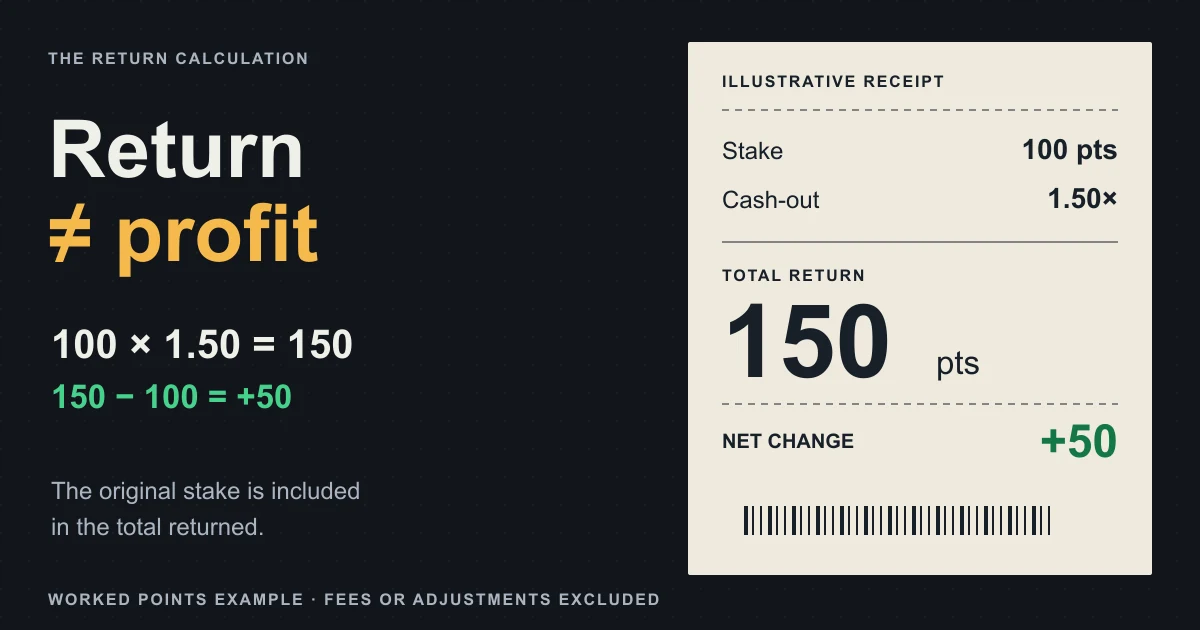
Total return = stake × cash-out multiplier.
Net change = total return − stake.
The second line prevents a common counting mistake: treating every returned point as a gain. If you start with 100 points and receive 150, your result is not a 150-point gain. You have recovered the original 100 and gained another 50.
Use the same unit throughout a calculation. These examples use virtual points and assume no fees or payout cap unless stated otherwise. They do not represent a balance available to withdraw.
Use the cash-out and session calculator to check these figures and add losing entries to the same ledger.
A slot award needs an additional check before this subtraction: does its multiplier apply to one line or the whole stake? The Master Slots paytable example works through that distinction.
Does a 2× cash-out mean double the profit?
No. With a 100-point stake, a confirmed 2.00× cash-out returns 200 points in total and earns 100 points above the stake. A 200-point net profit would require a 300-point total return, or 3.00×, before separate adjustments.
Worked examples with different amounts
| Stake | Cash-out | Total return | Net change |
|---|---|---|---|
| 100 pts | 1.20× | 120 pts | +20 pts |
| 100 pts | 1.50× | 150 pts | +50 pts |
| 200 pts | 1.75× | 350 pts | +150 pts |
| 50 pts | 2.00× | 100 pts | +50 pts |
For the 200-point example, calculate 200 × 1.75 = 350. Subtracting the stake gives 350 − 200 = 150. The last row also has a 50-point net gain, but uses a different stake and multiplier. The total return alone does not explain how a result was reached.
Convert a result to a percentage carefully
A 1.50× total return equals 150% of the stake. Its net gain is 50% of the stake: (150 − 100) ÷ 100 × 100%. More generally, before adjustments, the net percentage for a successful cash-out is (multiplier − 1) × 100%.
This is a description of a completed result, not its probability. A 50% net gain does not mean a 50% chance of collecting it. It is also different from a game’s long-run RTP; the RTP and house-edge article explains that distinction.
A crash before cash-out returns zero
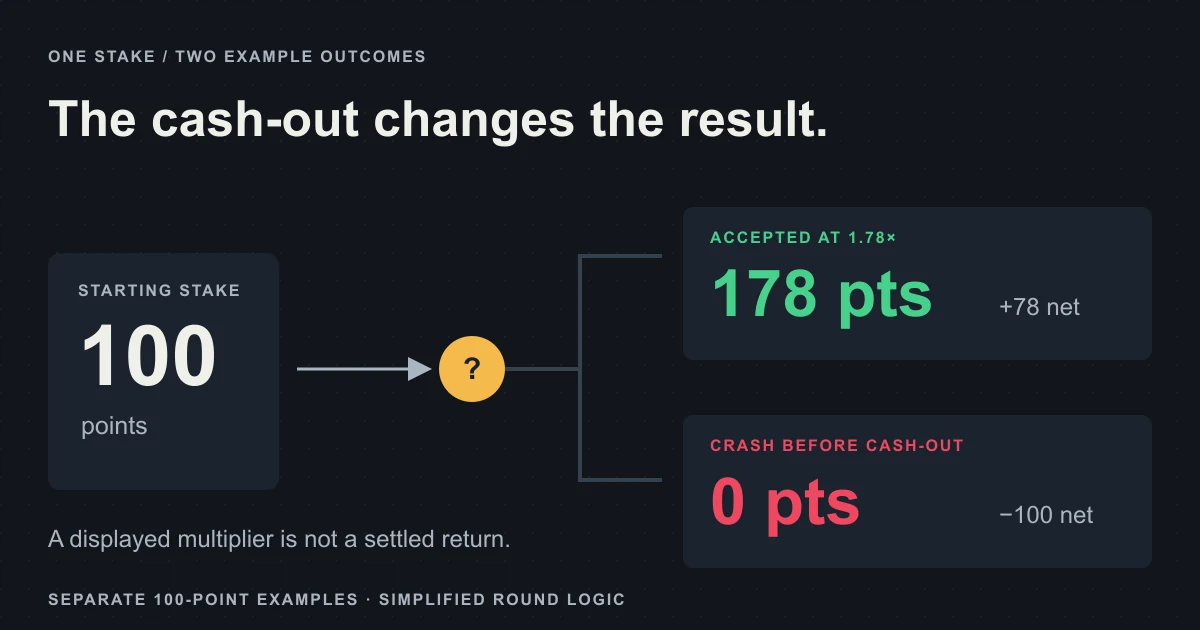
For a round that ends before cash-out, use zero as the total return. With a 100-point stake, the calculation is 0 − 100 = −100 points. The loss equals that round’s stake.
Do not multiply the stake by the final crash value to calculate a return for an uncollected round. If a round ends at 2.47× and there was no successful cash-out, 100 × 2.47 is not its return.
Add the results of every round
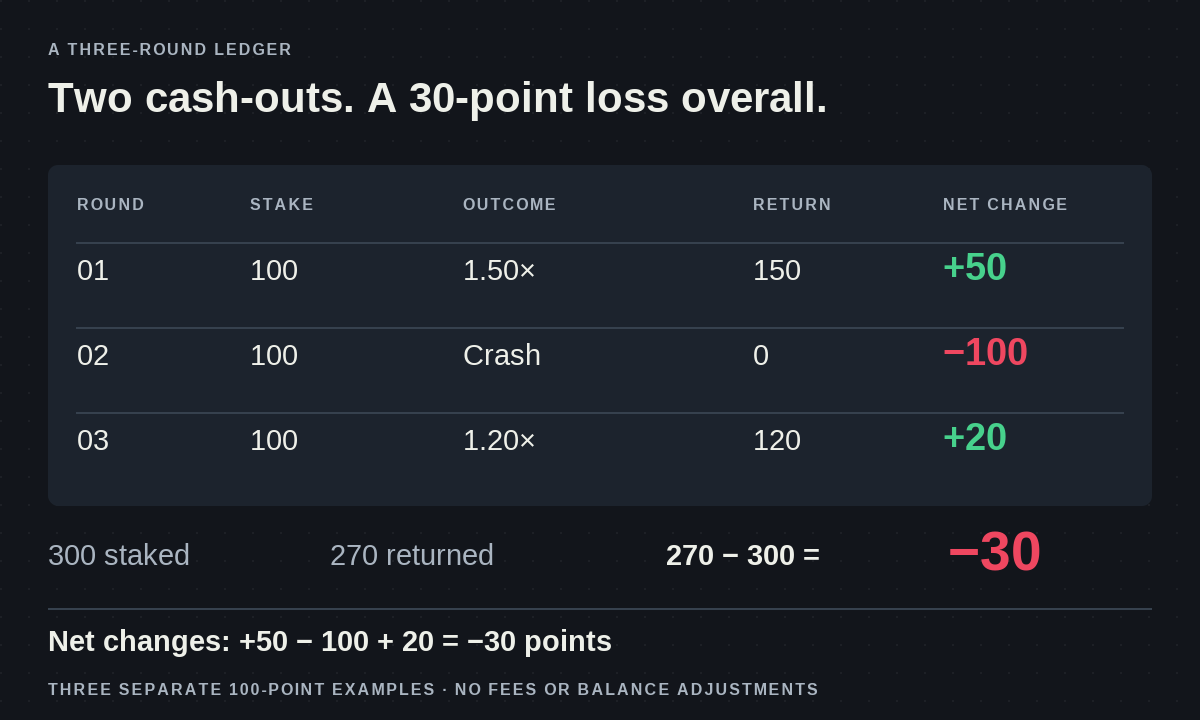
A sequence needs a record of losses as well as cash-outs. Consider three separate 100-point examples:
| Round | Outcome | Return | Net change |
|---|---|---|---|
| 1 | Cash-out at 1.50× | 150 pts | +50 pts |
| 2 | Crash before cash-out | 0 pts | −100 pts |
| 3 | Cash-out at 1.20× | 120 pts | +20 pts |
The combined stakes are 300 points and the combined returns are 270 points. The net result is −30 points. Two completed cash-outs did not produce a positive overall result. Counting successful rounds without their amounts would miss that difference.
With an opening balance of 1,000 points and no deposits, withdrawals or adjustments, the closing balance would be 970. The 300 points staked are turnover: some of the same balance can be committed again across rounds. They are not an additional 300-point deposit.
When the closing balance includes top-ups or withdrawals, use the wallet reconciliation example to separate funding from game results.
Check rounding before comparing numbers
The site demo calculates its example from the displayed two-decimal multiplier, then rounds the point return to a whole number. For instance, 20 points at 1.23× gives 24.6, displayed as 25 points.
A different system might retain more precision. In a hypothetical record, 72.5 points multiplied by an accepted value of 1.237 gives 89.6825. Rounding that return to two decimals gives 89.68. Multiplying by a display shortened to 1.24 instead gives 89.90, a difference of 0.22. Both calculations cannot be substituted for one another without knowing which multiplier the settlement uses.
Keep full precision during your arithmetic, then apply the stated rounding rule once at the end. The example above is not how our whole-point demo accepts an amount; it illustrates why a rounded screen value may be insufficient for reconciling another product’s record.
Keep fees and limits separate from the multiplier
Suppose a hypothetical service settles 100 points at 1.50× and then lists a separate 2-point charge. The gross return is 150, the amount credited after that charge is 148, and the net change is +48. Subtracting the charge from the stake before multiplication would be a different rule. Use the actual itemisation rather than inventing a fee to explain a mismatch.
Limits also need precise names. Bustabit’s limits FAQ distinguishes a maximum profit from a stake and describes forced cash-out when its limit is reached. That is a rule for that product, not a Master Crash limit.
For a hypothetical net-profit cap of 150 points on a 100-point stake, the corresponding total return is 250, not 150. Whether a product forces an earlier cash-out, rejects the entry or applies another treatment must come from its rules. A planned multiplier alone cannot settle that question.
A practical reconciliation order
- Confirm the entry was accepted and identify its final status.
- Use the recorded stake and accepted cash-out value, not the round’s later peak.
- Apply the stated precision and rounding rule.
- Account separately for any documented cap, fee, refund or adjustment.
- Compare the resulting credit with the ledger for that entry.
If a difference remains, keep the original record and calculation together. Guessing from an animated curve will not reveal which input or rule differs.
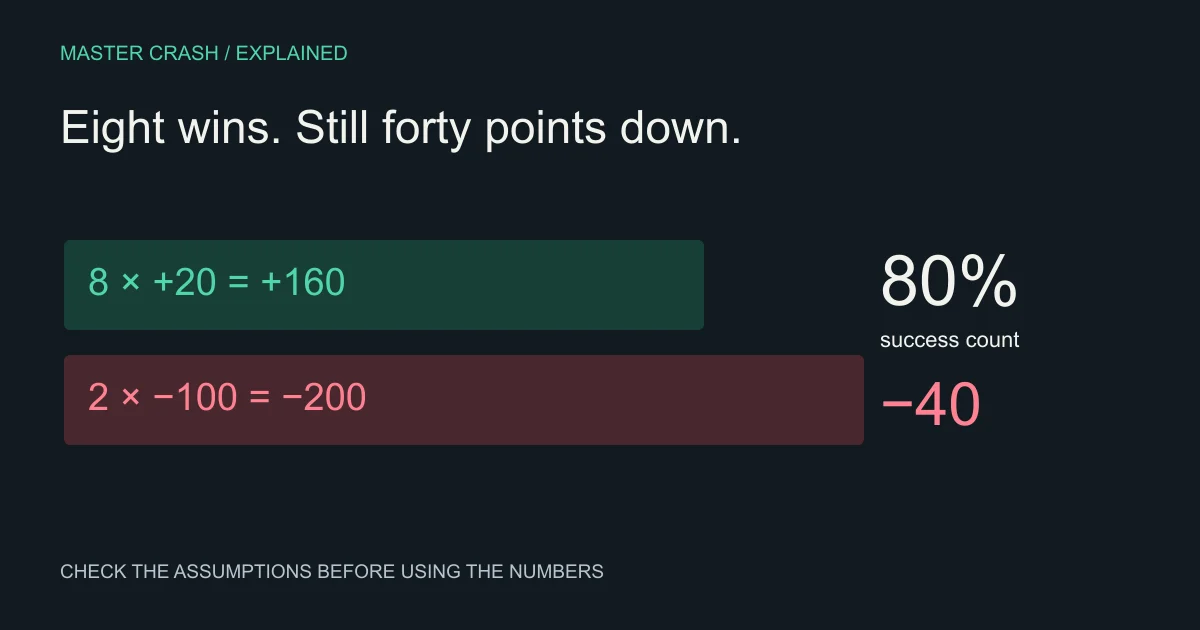
Compare the same success count with equal stakes and larger losing entries.
Sources & further reading
- Bustabit: maximum profit and wager limits
- Master Games: basic stake and cash-out relationship
- Master Crash browser demo and rounding examples
Worked examples are illustrative. Operator documentation describes that operator’s product and is not an independent audit of the games discussed here.
Try the cash-out example
Use virtual points to see the return calculation while a demo round runs.
Open the demo