The missing top-up changes the answer
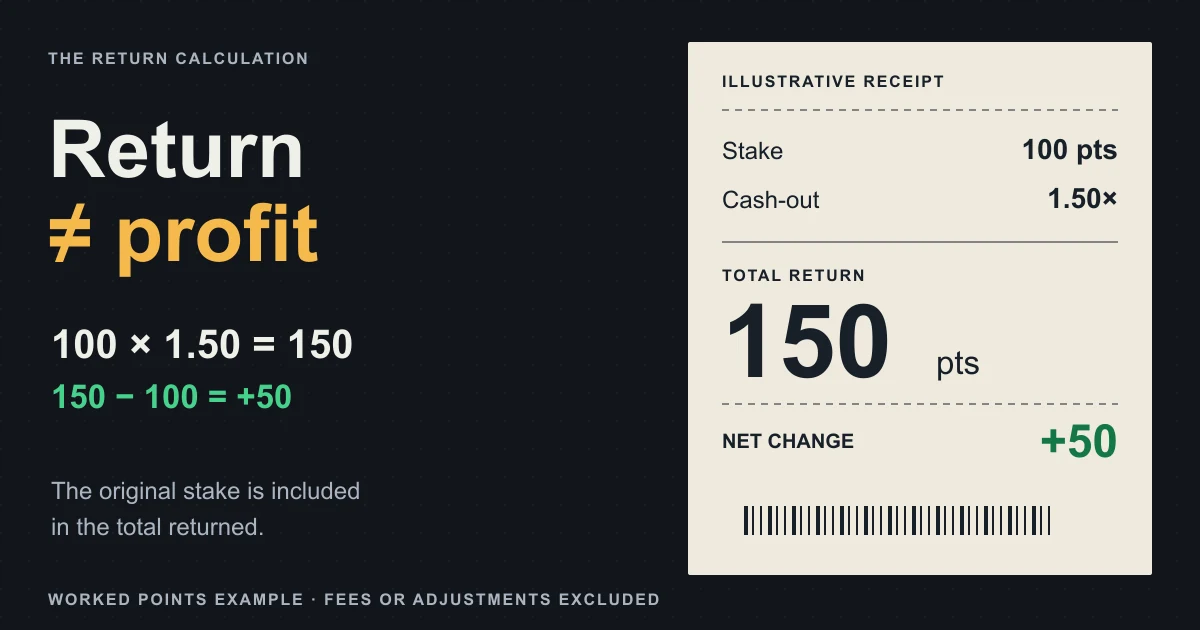
Take this invented session, in a single points wallet. There are no fees, bonuses or unsettled entries. The opening balance is 1,000. Three entries stake 100 points each and return 150, zero and 100 points. A separate top-up adds 500 points, and a withdrawal removes 300.
| Event | Change | Balance |
|---|---|---|
| Opening balance | — | 1,000 |
| Entry A: stake 100, return 150 | +50 | 1,050 |
| Top-up | +500 | 1,550 |
| Entry B: stake 100, return 0 | −100 | 1,450 |
| Entry C: stake 100, return 100 | 0 | 1,450 |
| Withdrawal | −300 | 1,150 |
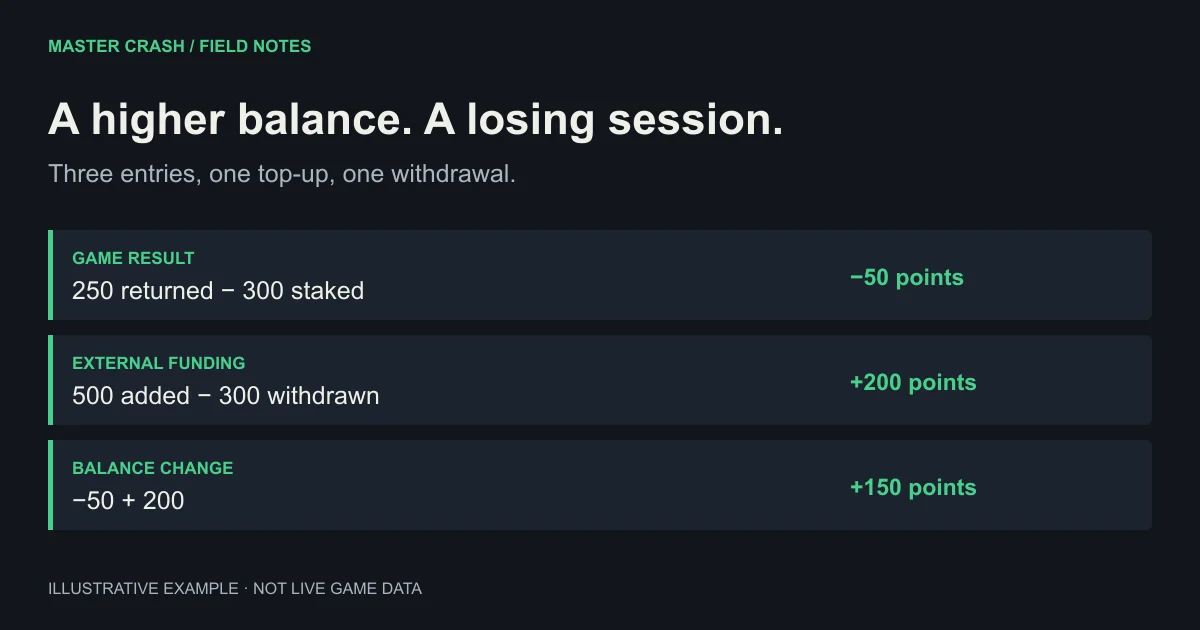
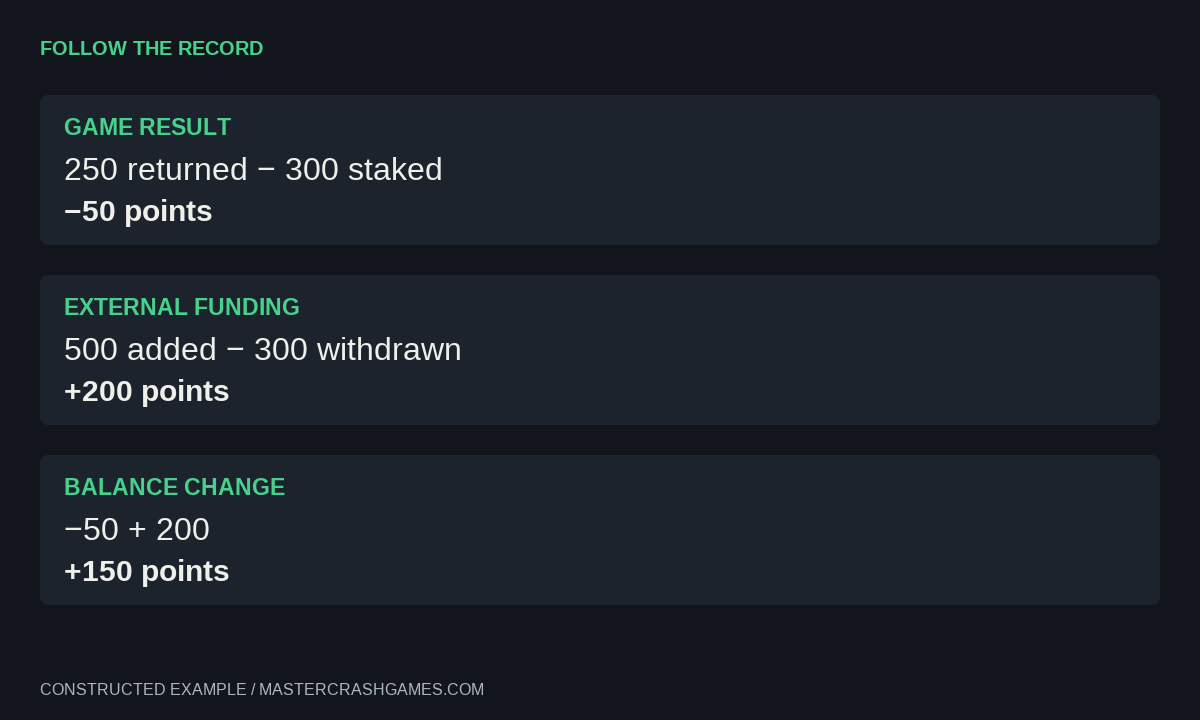
The entries lost 50 points: 250 returned minus 300 staked. The account gained 150 because it also received 200 in net external funding. Both statements are true. Calling the entire balance increase “winnings” would confuse money added to the wallet with the result of the entries.
Check the wallet and the entries separately
For this simplified wallet, game net = closing balance − opening balance − top-ups + withdrawals. Here that is 1,150 − 1,000 − 500 + 300 = −50. The independent entry check gives 150 + 0 + 100 − 300 = −50. Agreement between the two is useful: it means this particular ledger reconciles.
A real statement may have adjustments that our example excludes. A promotional credit, fee, refund or transfer between wallets needs its own signed movement. Record a credit as positive and a debit as negative, then subtract the sum of those non-game movements from the balance change. Do not silently label an unexplained difference a game loss.
The session calculator checks the stake-and-return side. It does not import wallet movements or determine whether a payment was processed. Keep those records beside the calculation rather than entering a deposit as a winning round.
Choose a cutoff that both records can use
Write down the opening and closing time, including the time zone. A wallet export ending at midnight and a round export ending an hour earlier can disagree without either file being wrong. An entry accepted before the cutoff but settled afterward also crosses the boundary.
Choose a period with no unresolved entries at either end where possible. Otherwise list the outstanding entries separately and document whether the wallet reserves their stakes. Keep available balance separate from total balance if the service exposes both. Comparing one with the other creates a difference before any arithmetic begins.
Match by entry or transaction identifier, not by timestamp alone. Two identical 100-point stakes can occur within the same displayed minute. A duplicated export row can look equally plausible. Preserve the original export and make corrections in a working copy so that each exclusion remains explainable.
A return percentage answers a smaller question
The entries in our example returned 250 ÷ 300 = 83.33% of the points staked. Dividing by the 500-point top-up instead would give 50%, but that denominator measures funding, not play. Reused points can be staked more than once, so turnover need not equal deposits.
The UK Gambling Commission’s RTP monitoring guidance uses returns relative to turnover and discusses sampling variability. Our three invented entries establish only their own accounting result. They cannot establish a product’s theoretical RTP or prove that a game is behaving as designed.
If there is still a difference, name it
Suppose the same records show a closing balance of 1,145. The explained balance is 1,150, leaving an unexplained five-point debit. That is the issue to investigate. Check for a fee, a missing settlement, a reversal or a wallet transfer; do not invent a five-point loss to force the columns to agree.
A useful support request gives the period, wallet unit, expected closing balance, actual closing balance and relevant identifiers. Send the minimum necessary records through a verified support channel, with unrelated personal details removed. A clean five-point discrepancy is easier to examine than a claim that “the balance is wrong.”
Sources & further reading
Worked examples are illustrative. Operator documentation describes that operator’s product and is not an independent audit of the games discussed here.