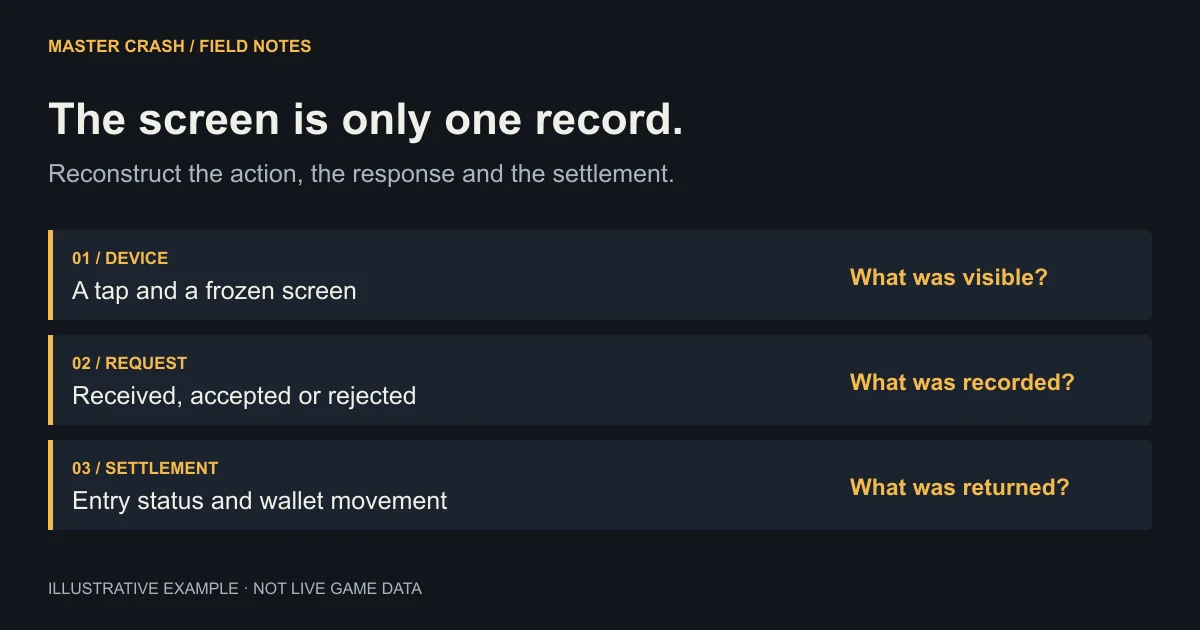
There are three events to reconstruct
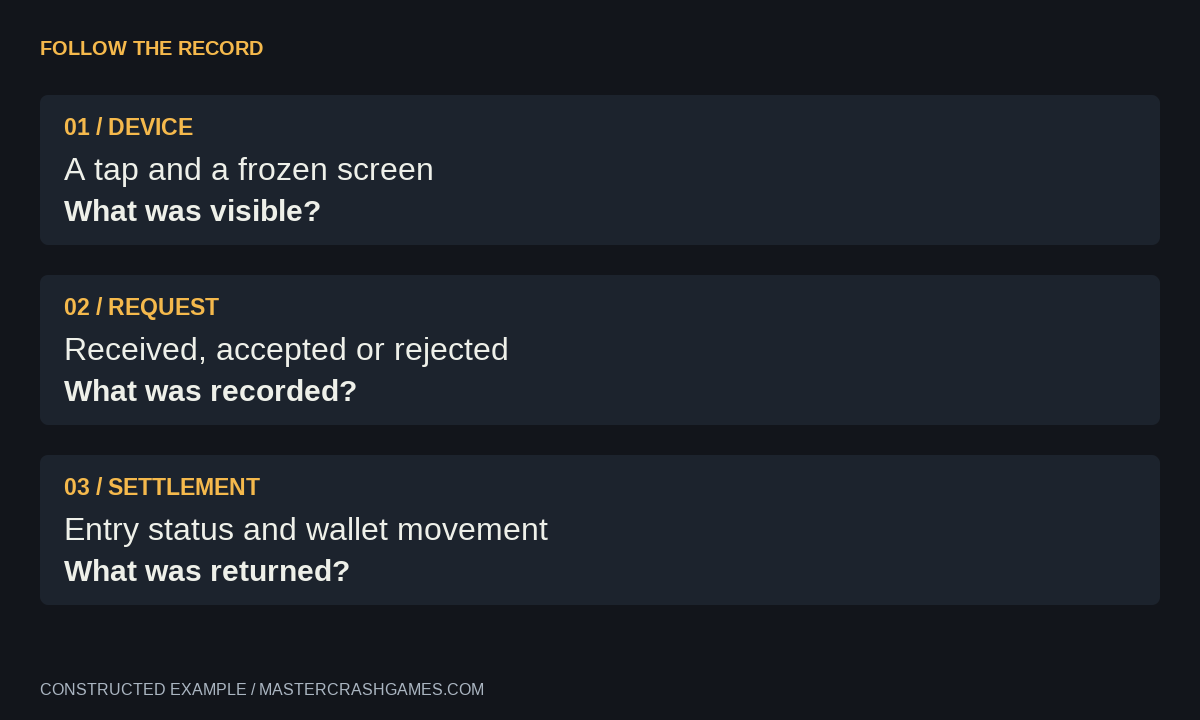
Separate the local action, the service’s response and the final settlement. “I pressed the button” describes an action on the device. An accepted cash-out record describes a decision recorded by the service. A wallet credit describes the resulting balance movement. These can be different records with different timestamps.
Consider an illustrative timeline: the device shows 1.80×; the user taps; the connection drops; the completed history later shows the entry as lost. That sequence leaves a gap. The request might not have arrived, might have been rejected, or might have been accepted but followed by a settlement error. The frozen animation alone cannot distinguish those possibilities.
Do not calculate a refund from the highest number visible on the screen. First establish which event the operator recorded and which rule applies. We do not have verified Master Crash interruption or request-ordering documentation, so this article cannot assign a settlement outcome to that scenario.
Save the identifiers before changing the app
Record the round ID, entry ID, stake, selected automatic target if any, displayed status and final returned amount. Add the local time and time zone, app or browser version, device type, and whether the connection used mobile data or Wi-Fi. Keep the original screenshot or recording rather than only an annotated crop.
These details narrow the search; they do not independently prove fault. A screenshot with no entry identifier may belong to a different stake in the same round. A recording showing a tap provides more context than a still image, but still does not establish when a remote service processed it.
After reconnecting, capture the completed entry and relevant wallet transaction. Avoid reinstalling or clearing app data before saving records you may need. Do not place another stake to “test” whether the old one was accepted: a new entry adds a separate financial event without resolving the first.
Find the interruption rule for the actual product
A general help page may discuss server outages while your issue involves one disconnected device. Look for separate treatment of those cases, pending entries, stored automatic targets and requests received near the end of a round. Save the policy URL and the version or date shown.
As a reference for how detailed such policies can be, the UK Gambling Commission’s RTS 10 discusses different interruption scenarios and disclosure of interruption policies. It does not prescribe a universal refund for every disconnected screen. This is a Great Britain regulatory reference, not evidence that Master Crash holds a particular licence or follows that standard.
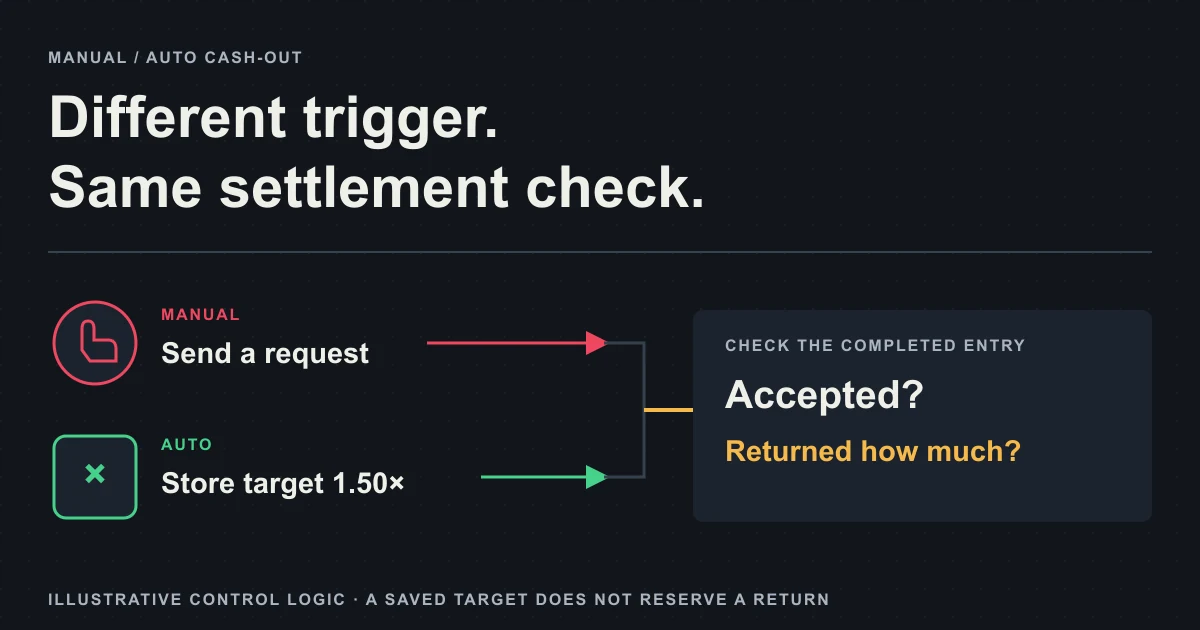
An automatic cash-out also needs context. A target visible in a field is not necessarily evidence that it was saved for the accepted entry. Ask for the target attached to that entry and its recorded status. The manual and automatic cash-out guide explains the distinction between a setting and a settled result.
Ask a question the records can answer
A focused request might read: “For entry [ID] in round [ID], please confirm whether a cash-out request was received, its recorded time and status, the settlement amount, and the interruption rule used. My device disconnected at [time and zone]. I have attached the completed entry record and a redacted screenshot.”
If an automatic target was involved, ask which target was recorded for the entry. If support supplies a timestamp, ask which time zone and event it represents. Device and server clocks may not match closely enough to infer ordering from two rounded display times.
Keep the ticket reference and response. A reply saying only “connection issue” does not explain the accepted request status or policy. A reply giving those fields is more useful, even when the result is disappointing. Share account evidence only through a support channel you have independently checked; passwords and one-time codes do not belong in the ticket.
Separate an unresolved record from a proven defect
Missing evidence is a reason to keep the case open, not evidence of a particular technical cause. Equally, a recorded loss does not by itself explain why a request failed. Preserve the gap in the account instead of filling it with assumptions about speed, server location or a rigged round.
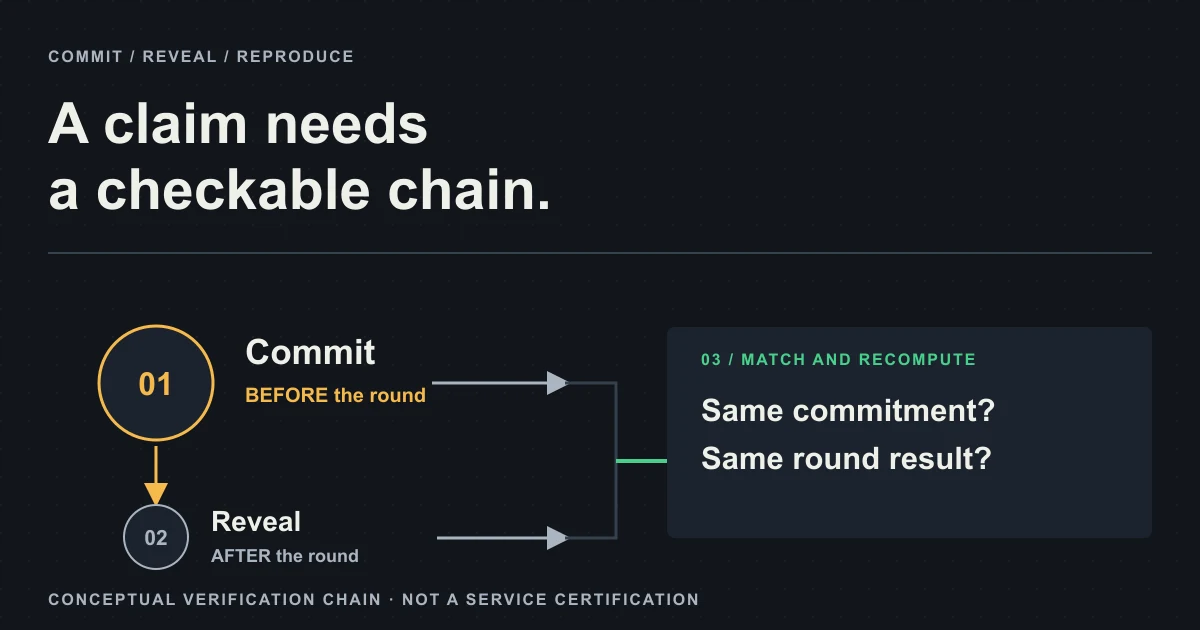
A fairness check answers another question. Reproducing a round outcome from disclosed inputs does not prove that your personal request was processed correctly. For that distinction, see the three scopes of fairness verification. The final explanation should connect the entry record, the settlement and the applicable rule.
Sources & further reading
Worked examples are illustrative. Operator documentation describes that operator’s product and is not an independent audit of the games discussed here.