The crash point is not your cash-out
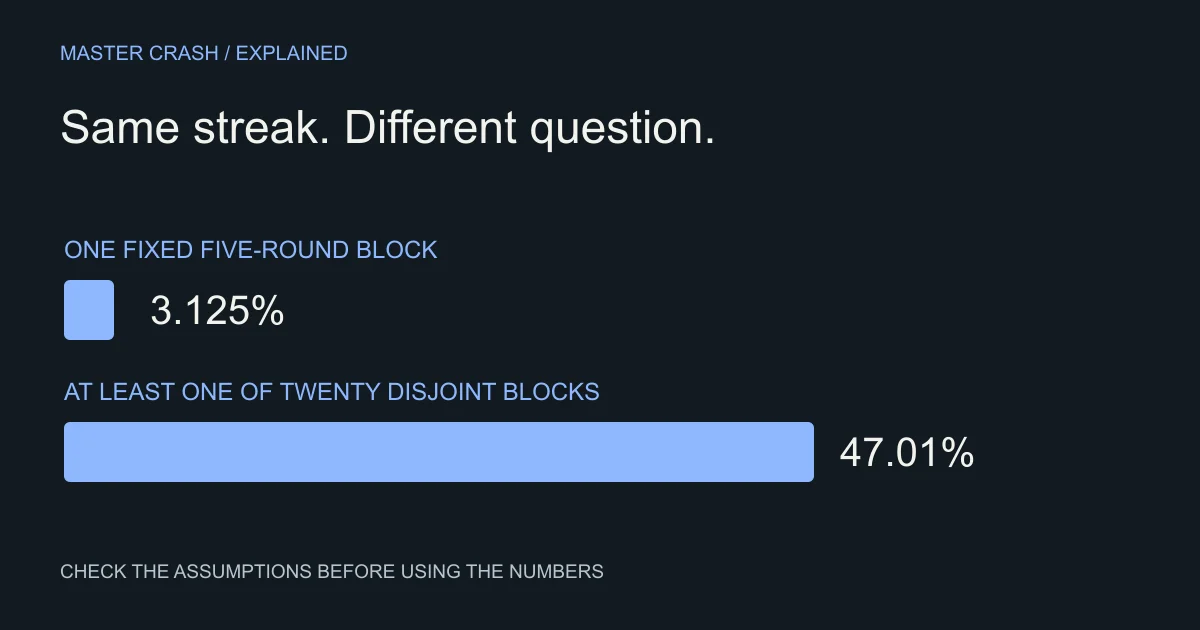
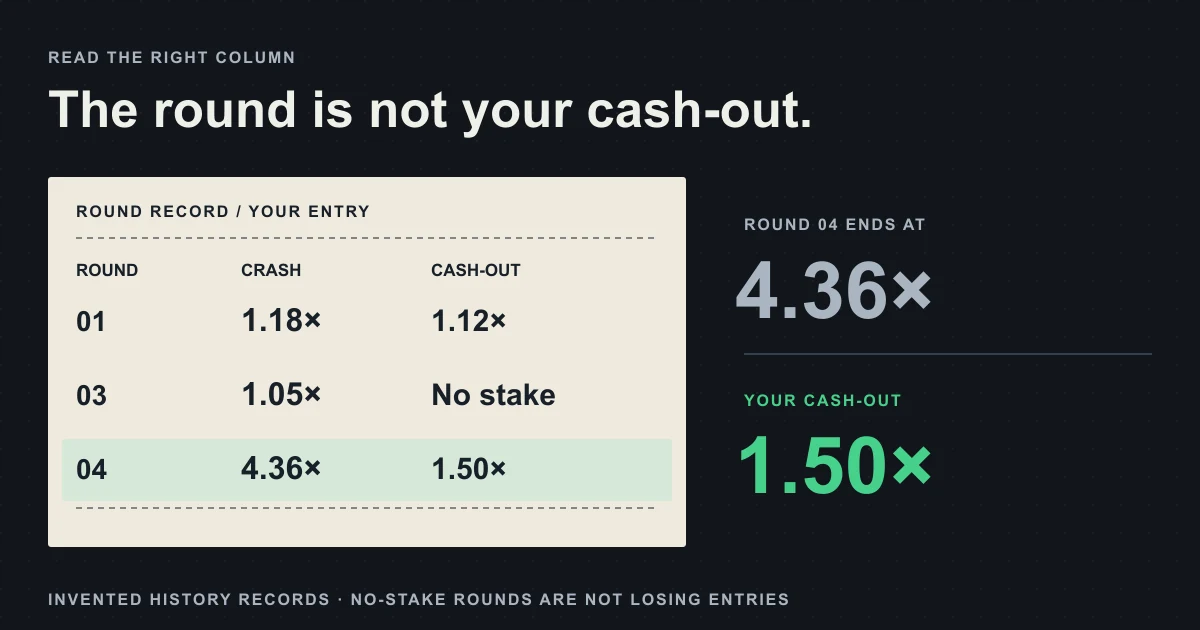
If a 100-point entry cashed out at 1.50× and the round later ended at 4.36×, its total return is 150 points. Recalculating it at 4.36× would describe a different cash-out. A round-level result and an entry-level settlement answer different questions.
Bustabit’s published game-object documentation separates the crash value, personal cash-out and wager. Its nullable cash-out field can also represent more than one state. That distinction is useful when reading records, although field names and formats differ across apps.
The following is an invented record, not collected game data. Each participating round starts with 100 points. A dash means no stake was placed.
| Round | Crash point | Your cash-out | Total return |
|---|---|---|---|
| 1 | 1.18× | 1.12× | 112 pts |
| 2 | 2.42× | None accepted | 0 pts |
| 3 | 1.05× | No stake | — |
| 4 | 4.36× | 1.50× | 150 pts |
| 5 | 1.62× | None accepted | 0 pts |
Why can the history show 3× when my return used 1.5×?
The history can show the final crash point for the shared round, while your entry records an earlier accepted cash-out. A 100-point entry at 1.50× returns 150 points even if the round later ends at 3.00×. Compare the entry and round records separately.
Add the stakes as well as the returns
Four stakes of 100 total 400 points. The returns are 112 + 150 = 262, so the net result is 262 − 400 = −138 points. Counting only successful cash-outs hides losing entries. Counting round 3 as a loss is also wrong, because no stake was placed.
A history window is not necessarily a full account ledger. It may omit earlier rounds, deposits, withdrawals, adjustments or another table. To reconcile a balance, define the starting time and account scope, include every entry in that interval, and keep game returns separate from money added or removed. This arithmetic can be checked without assuming any probability distribution.
A short sequence is not a forecast
The Master Games guide describes rounds as independent. A run of low results therefore does not establish that a higher result is due next.
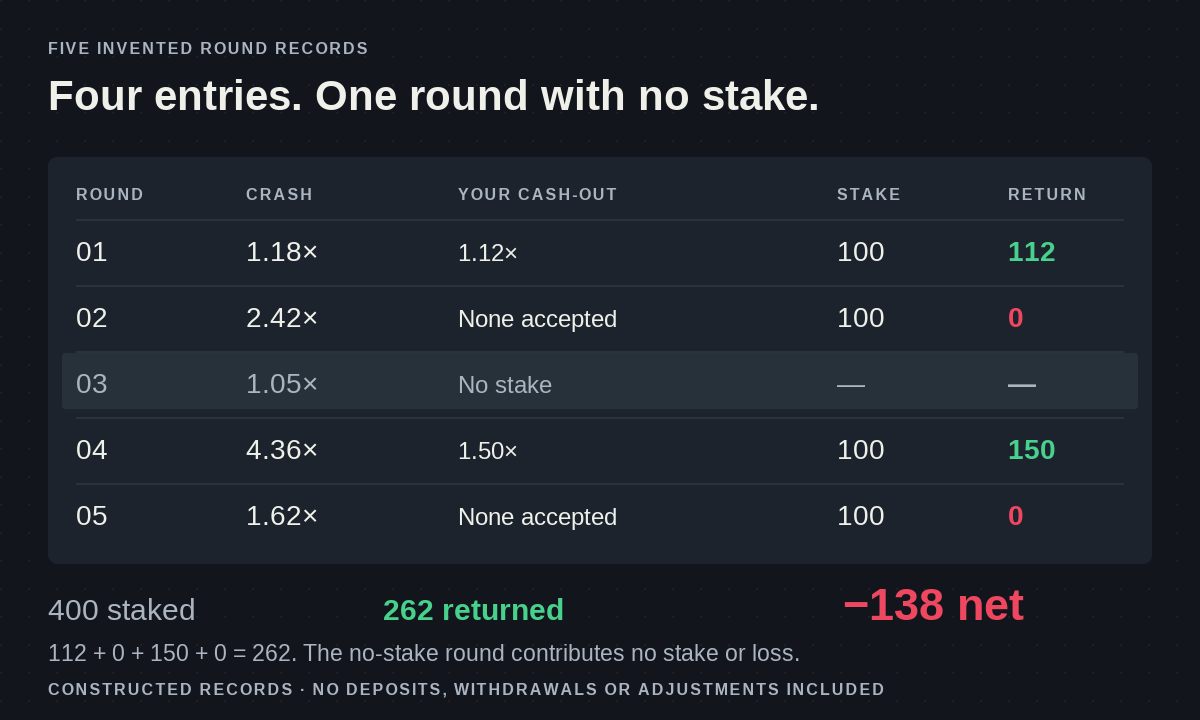
For a separate mathematical illustration, suppose an invented independent process has a 50% chance of a result below a chosen threshold. Five such results in the next five rounds have probability 0.5⁵ = 1/32, or 3.125%. After four have already occurred, the assumed chance for the fifth remains 50%. The probability of the whole sequence and the conditional probability of the next event are different quantities.
This is not a claimed probability for Master Crash or any cash-out target. Without a verified distribution, a threshold’s actual likelihood is unknown. Nor does 1/32 mean that a five-round streak arrives on a schedule every 32 rounds.
Check how the sample was chosen
SPRIBE’s Aviator product page describes live-bet displays and leaderboards of large wins. Those views have a different purpose from a complete record of all entries, including losses.
A screenshot selected because it contains an unusual multiplier is not a random sample. A player who posts only successful cash-outs creates the same problem. Before calculating a success rate, ask which rounds were eligible, whether anything was omitted, and whether the period was chosen before seeing the results.
Even an honest small sample is imprecise. In a hypothetical 20-entry sample, 11 successes produce an observed rate of 55%; one changed result moves it by five percentage points. This count does not reveal the size of the returns, the losses, or a stable future success rate. Testing many patterns on the same short list also increases the chance of finding one that looks convincing by coincidence.
A rolling window also changes after each new round. Two screenshots taken a minute apart can contain mostly the same observations; treating them as two independent samples would count those shared rounds twice.
What a verified result can establish
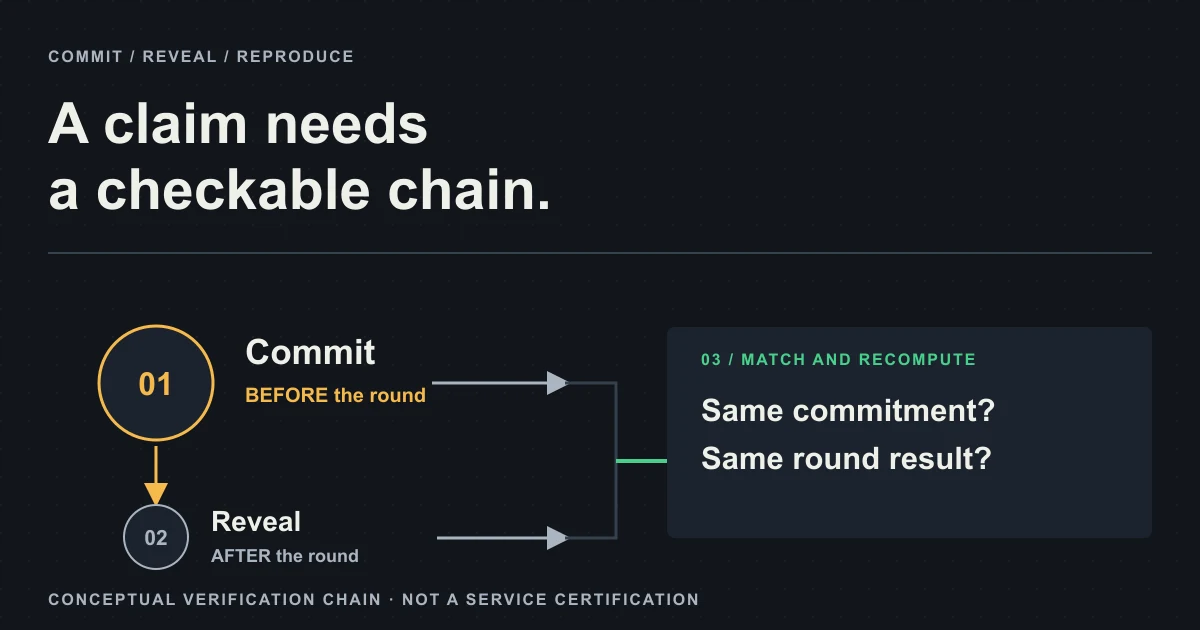
A completed-round check may establish that a published crash point matches specified inputs and an announced algorithm. It does not automatically establish that a personal cash-out request arrived before that point, that every settlement was correct, or that a withdrawal was processed.
Similarly, one matching result does not certify a whole service. Keep round verification, entry settlement and account reconciliation as separate checks. The provably fair verification guide explains the required evidence and why a hash alone is incomplete.
Save a record someone can check
For a disputed entry, retain the round identifier, time and time zone, stake, requested cash-out, accepted value if shown, total return and any error message. Keep the original export or receipt if the app provides one. With multiple entries in the same round, identify the particular entry as well.
A cropped curve screenshot may omit the identifier or show a moment after your entry ended. Include enough context to connect the evidence to the queried entry, and use the actual operator’s support channel. Do not include an OTP, password or payment PIN. If the record remains unresolved, mark it unknown rather than silently treating it as a win or loss in a personal calculation.
Practice checking one result
Use the virtual-points demo to record a starting amount, accepted multiplier and return, then check their arithmetic. Its repeating, scripted sequence is unsuitable for estimating real-game probabilities. It is a controls example, not a dataset for a predictor.
Sources & further reading
- Bustabit official scripting documentation: game-object fields
- SPRIBE Aviator: live bets and leaderboard descriptions
- Master Games: independent-round description
Worked examples are illustrative. Operator documentation describes that operator’s product and is not an independent audit of the games discussed here.
Try the cash-out example
Use virtual points to see the return calculation while a demo round runs.
Open the demo