Keep three checks separate
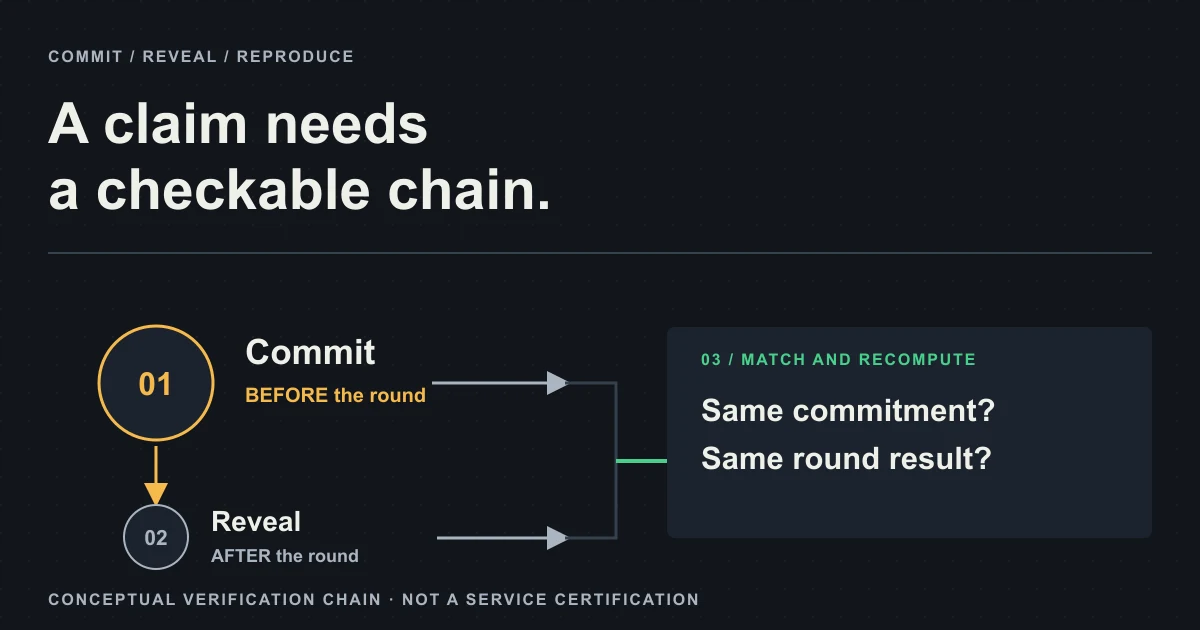
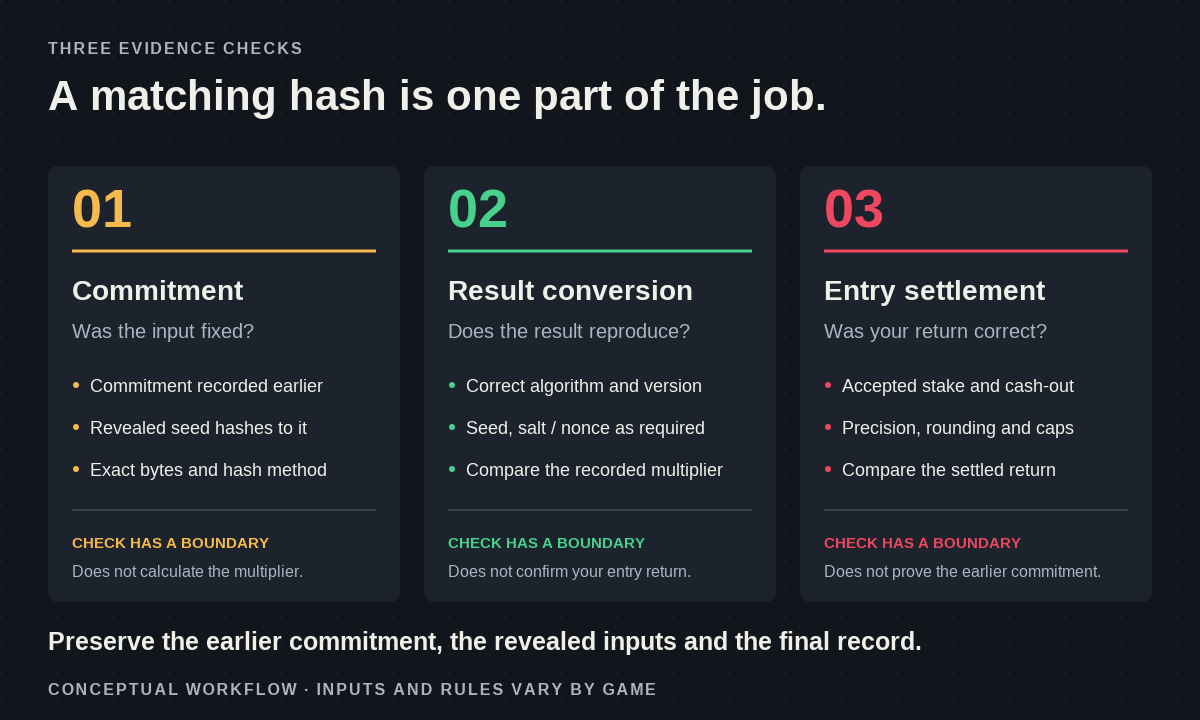
A verification has three different jobs. First, establish that a commitment was available before the relevant decisions were made. Second, check that the later revealed material matches it. Third, run the appropriate result calculation and compare its output with the completed record.
A screenshot of a revealed seed only addresses part of that chain. Without the earlier commitment, it does not establish when the value was fixed. Without the conversion algorithm, matching a seed hash does not explain how the recorded multiplier was obtained.
When an operator offers a verification badge, look for the underlying inputs and method. A useful check produces something reproducible, not just another reassuring label beside the same result.
Does a matching hash prove that the payout is correct?
A matching commitment helps check that revealed data corresponds to the earlier digest. Reproducing the round also needs the documented algorithm and all required inputs. Neither check, by itself, proves that an account received a payment or predicts the next crash.
A hash is a digest, not encrypted seed text
A cryptographic hash maps input bytes to a fixed-size digest. NIST’s Secure Hash Standard describes message digests as a way to detect changes. Hashing is not encryption: there is no decryption key that turns the digest back into its original input.
In a simple commitment example, someone keeps a sufficiently unpredictable secret and publishes its digest. Later, they reveal the secret, allowing others to hash it and compare the answer. The security also depends on the secret being hard to guess; hashing a short, predictable word does not make that word secret.
The example below deliberately uses an obvious phrase so that the arithmetic can be repeated. It is not a suitable seed-generation design and is not a real game round.
A small SHA-256 example you can reproduce
Hash the UTF-8 bytes of example-seed, with no surrounding quotation marks and no trailing newline. The input bytes in hexadecimal are 6578616d706c652d73656564. The SHA-256 digest is:
cd139b161afd30dee3e1924f98dbae55ed2206c803f2a1dff5f4b6b62ce0d9f7Now append one newline character. The digest changes to:
6b061d45d659b957c59779825c5c92113098e80121692f1a296d60bc85640170These original test values were computed locally for this article. If the first digest had been saved earlier, revealing exactly the first input would pass the comparison. Revealing the newline variant would fail.
This check says nothing about a multiplier yet. It only compares input bytes with a digest. A separate, documented conversion is needed to turn the verified data into a game result.
Use the protocol for that game and version
There is no universal Crash verification formula. As one published example, Stake’s implementation documentation describes an HMAC-SHA256 byte generator using server and client seeds, a nonce and a cursor. That page describes its implementation; it is not evidence that every Crash game uses those inputs.
Bustabit’s verifier repository supports different hash chains. Its verification worker distinguishes older text-encoded hashing from binary-input hashing and contains branches for different historical calculation schemes.
That is why copying a formula from a similarly named game can fail even when all the visible numbers look plausible. Confirm the game identifier, applicable chain or algorithm version, any public salt and the exact input format. Do not infer Master Crash’s implementation from these examples; this site has not verified its live protocol.
A practical workflow for a completed round
- Identify the record. Save the round identifier, recorded crash multiplier, relevant time and the operator’s game name. A player cash-out value and the final crash point are different fields.
- Find the earlier commitment. Keep the published hash or chain commitment and its context. Establish that it applies to the same round or sequence.
- Collect the revealed inputs. Depending on the documented scheme, these may include a seed, hash, round number, nonce, salt or signature. Some systems reveal data only after a seed rotation or another specified event.
- Choose the matching verifier. Follow the operator’s documentation to the correct implementation. Note the source version if it is available.
- Check the commitment and result separately. Compare the digest or chain relationship first, then recompute the result using the required conversion and precision.
- Keep the output. Record whether each check passed, rather than retaining only a green success message.
This workflow uses public verification data. It does not require an account password, OTP or payment PIN.
A mismatch needs diagnosis, not an immediate conclusion
| Mismatch | Check next |
|---|---|
| Seed digest differs | Whitespace, character case, text encoding and whether hexadecimal represents text or raw bytes |
| Digest matches, multiplier differs | Algorithm version, salt, round identifier, nonce and conversion precision |
| Round result matches, return differs | Accepted cash-out, stake, rounding, caps and settlement record |
| Required data is unavailable | The documented reveal schedule and whether the record is complete enough to verify |
A wrong input can explain a failure; a correct-looking input can also be incomplete. Preserve the evidence and ask the operator for the missing specification. Do not “fix” values until a verifier passes, because that breaks the connection to the original record.
What a successful check leaves unanswered
A correctly performed check can support that the selected result follows the specified committed data and algorithm. It does not, on its own, establish the quality of every implementation component, the reliability of the service or the treatment of funds. Those require different evidence.
Nor does a reproducible result imply a positive expected return. A transparent calculation can include a house edge, as the RTP worked example explains. Verification also differs from an independent audit: checking your selected round is narrower than assessing a complete system.
Finally, verifying revealed past data does not make unrevealed future data available. A site that asks for payment to “decrypt” a future crash from a hash is making a different claim entirely. Ask for a reproducible method and evidence instead of treating a past-round verifier as a prediction service.
Keep a result check separate from a settlement question
When raising a query, state which issue remains: commitment mismatch, conversion mismatch, unavailable inputs or an accepted return that does not match the ledger. Include the round identifier, input values, verifier version and calculation output. That gives someone a specific discrepancy to investigate.
Our browser demo uses scripted crash values and has no cryptographic fairness protocol. It explains controls and return calculations only. Do not mistake its repeating examples for a verification of the Master Crash app.
Sources & further reading
- NIST: FIPS 180-4 Secure Hash Standard
- Stake: provably fair byte-generation implementation
- Bustabit: official verifier repository
- Bustabit: version-specific verification worker
Worked examples are illustrative. Operator documentation describes that operator’s product and is not an independent audit of the games discussed here.