Eight small gains, two full losses
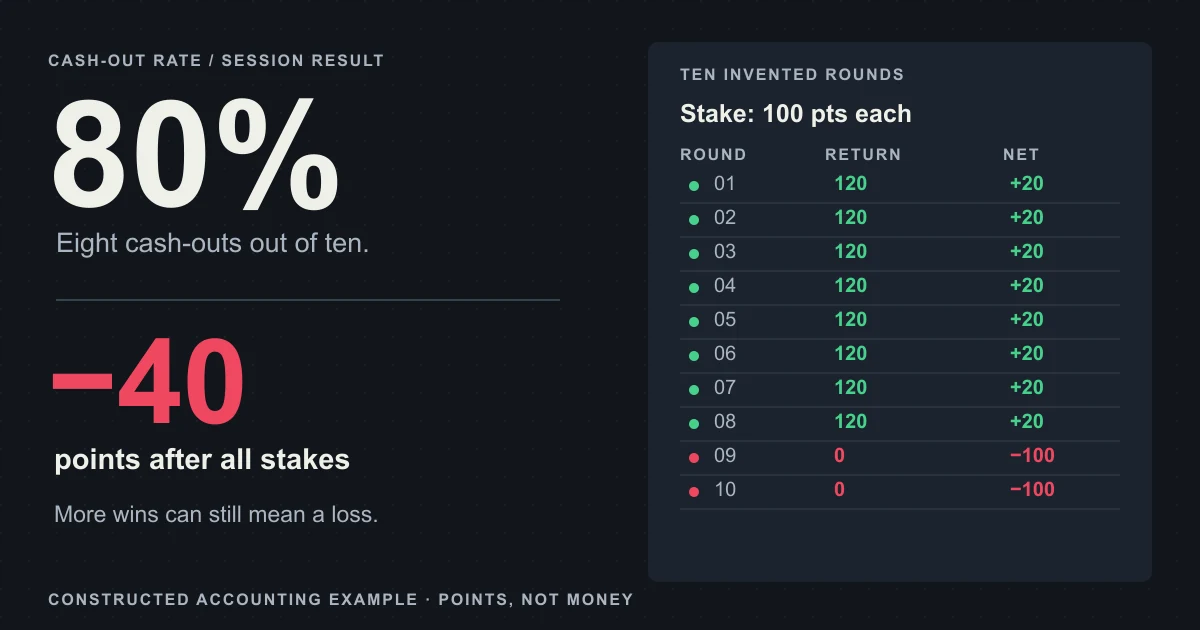
Consider ten completed entries of 100 points each. Eight settle successfully at 1.20×. Two crash before an accepted cash-out and return zero. These are invented records, with no fees, refunds or other adjustments.
| Result group | Total staked | Gross return | Net change |
|---|---|---|---|
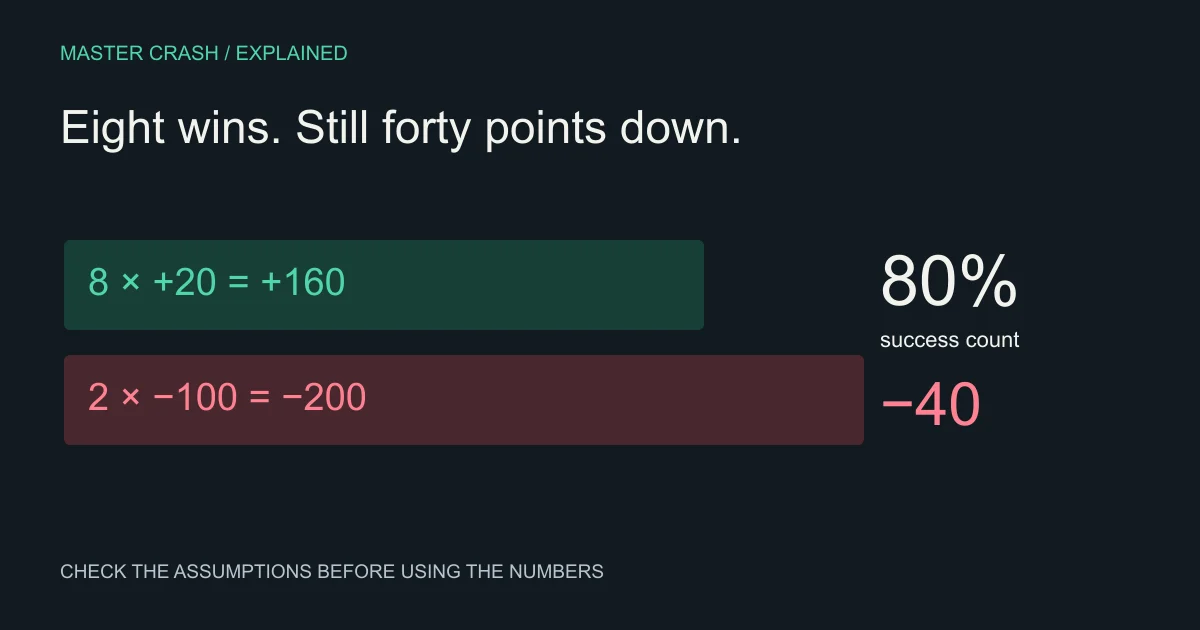
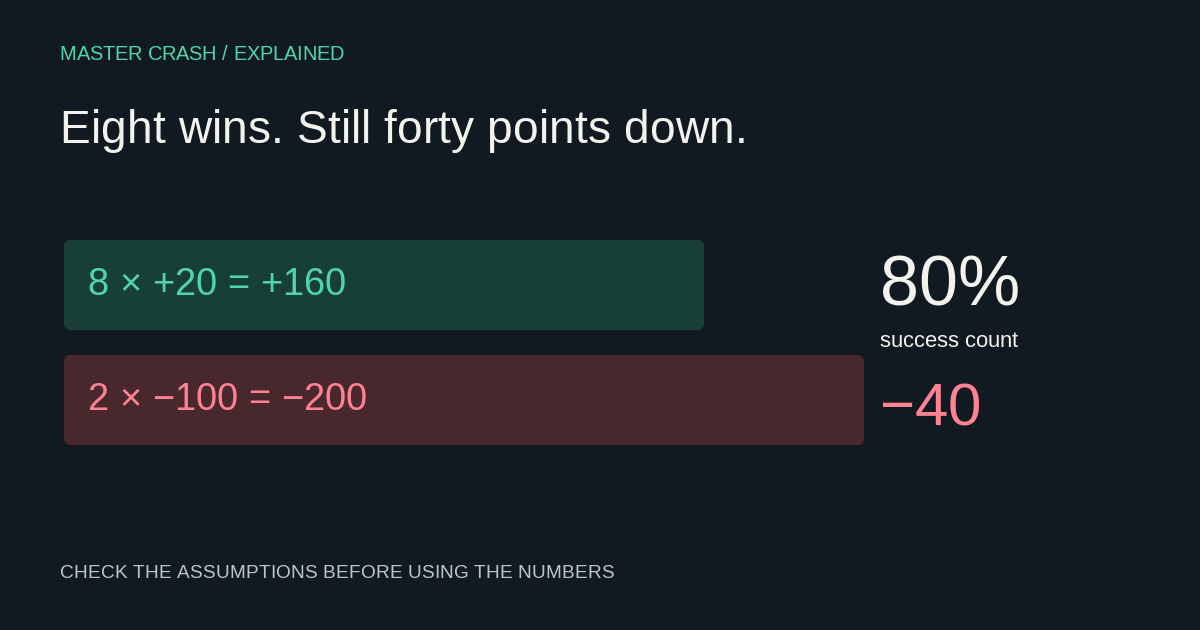
| 8 at 1.20× | 800 | 960 | +160 |
| 2 losses | 200 | 0 | −200 |
| All 10 entries | 1,000 | 960 | −40 |
Each successful entry earns 20 points above its original stake. Each unsuccessful entry loses 100. The eight gains add up to 160, which does not cover the 200 lost. Calling this an “80% winning strategy” describes the count while leaving out the result that matters.
There is another useful distinction: an accepted cash-out at exactly 1.00×, if a product allows one, only returns the stake before adjustments. A screen may label it as a successful action without it being a profitable entry. Define what “win” means before comparing statistics.
The break-even rate is an accounting threshold
For equal stakes, one fixed successful payout multiplier m and zero return on every failure, gross return divided by total stakes is p × m, where p is the successful fraction. The recorded sample breaks even when that product equals 1.
At 1.20×, the threshold is 1 ÷ 1.20, or about 83.33%. In a ten-entry sample, eight successes fall short; nine successes produce a gross return of 1,080 on 1,000 staked. This calculation says nothing about how likely nine successes are.
The distinction prevents a common mistake. Deriving a required success rate does not establish the actual success probability. You need the game’s documented outcome model to examine that separate question. Our RTP and house-edge guide explains why a smaller cash-out target is not evidence of an improved expected return.
The same win count can hide a much larger loss
Now keep the eight successful 100-point entries, but make each of the two failed entries 500 points. The count remains eight out of ten. Total stakes rise to 1,800, while total returns remain 960. The net result is −840 points.
A simple average of entry multipliers is not stake-weighted. It gives a 10-point entry the same influence as a 500-point entry. For a completed session, add the amounts first: sum the gross returns, sum the stakes, then subtract. Divide those totals only if you also want a return-to-stakes ratio.
The UK Gambling Commission’s monitoring glossary distinguishes stakes accumulated through play from the amounts returned. It also separates a game’s theoretical RTP from the result observed over a selected period. Those definitions help describe the ledger; they do not supply an RTP figure for Master Crash.
Four fields make the result checkable
Keep one row per accepted entry with its identifier, stake, final status and gross returned amount. Record refunds and adjustments separately instead of quietly reclassifying them as winning rounds. If the same round contains two entries, retain both entry identifiers.
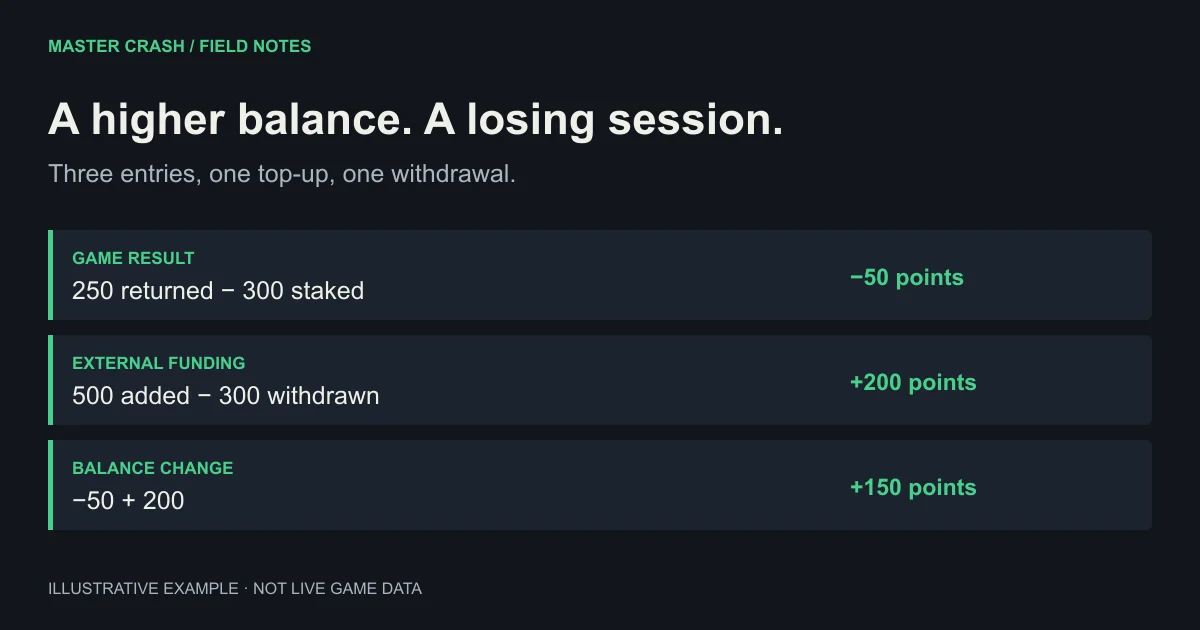
Use the cash-out calculator to check ordinary settled examples, including zero-return losses. It does not connect to an account or verify an operator’s records. A mismatch between the session result and a wallet balance needs a second calculation that includes deposits and withdrawals; see the balance reconciliation example.
For the ten equal stakes above, the useful statement is “960 returned on 1,000 staked, a 40-point loss.” Keep the 80% count as additional context. On its own, it cannot explain whether the session gained anything.
Sources & further reading
Worked examples are illustrative. Operator documentation describes that operator’s product and is not an independent audit of the games discussed here.