Start with the particular slot, not the lobby name
The Master Games product page describes Master Slots as a collection with individual paytables. That is a reason to record the specific title and version before interpreting an award. A collection name does not identify one universal set of symbol values.
This guide uses an invented 20-line game to show how to read a payout basis. Its numbers are not a Master Slots paytable, and we have not tested a live account. Keep the title, active lines, total stake and rules screen together when checking a real result.
A useful first question is: “Does this number multiply my total spin stake, my stake on one line, or another amount defined in the rules?” If the screen does not answer that, the payout cannot yet be calculated. A currency symbol or a small “per line” note matters more than the size of the printed multiplier.
The same 20× label can produce 100 or 2,000
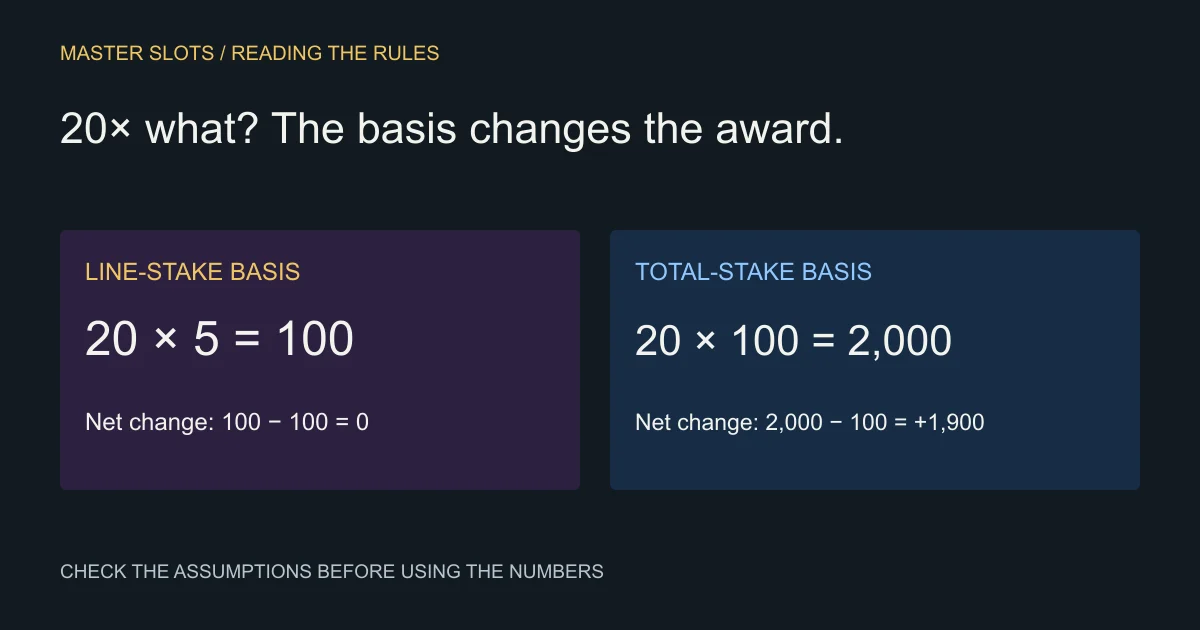
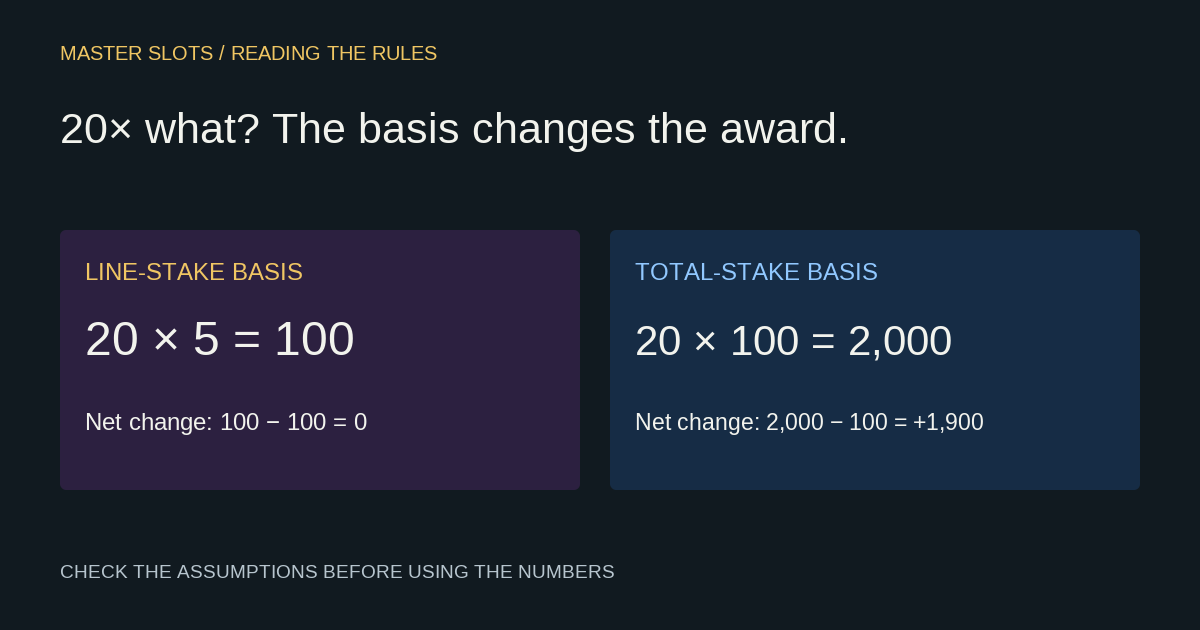
Assume 20 equally staked, active lines and a total spin stake of 100 points. Each line then carries 100 ÷ 20 = 5 points. If three matching symbols award 20 times the line stake, that one line returns 20 × 5 = 100 points.
| Award basis | Calculation | Gross award |
|---|---|---|
| 20× a 5-point line stake | 20 × 5 | 100 points |
| 20× the 100-point total stake | 20 × 100 | 2,000 points |
The first award merely recovers the 100-point cost of the whole spin. It is a winning line without a profitable spin. The second would produce a 1,900-point net gain. Neither interpretation is correct until the rules identify the stake basis.
If two eligible lines each award 100, and the rules add their awards, the total return is 200 and the spin’s net change is +100. Do not subtract the full spin stake once for each winning line; it was charged once for that spin. This is the same gross-return versus net-change distinction used in our Crash calculations, with a different way of determining the gross award.
Matching symbols are only part of the rule
Check the required direction, starting reel and number of adjacent matches. Three matching symbols scattered across the screen are not necessarily a winning line. A “ways” game can use a different evaluation method from a fixed-payline game, so a line-count formula should not be carried across unchanged.
Read the wild’s exclusions and the scatter’s separate conditions. A wild may substitute only for eligible symbols; a scatter may trigger a feature, pay a prize, or do both under the specific rules. Do not assume that every symbol labelled scatter pays anywhere, or that every wild substitutes for bonus symbols.
Another detail is whether the game pays only the highest combination on a line or adds several combinations. A screenshot of symbols is incomplete evidence without those evaluation rules. Save the result breakdown as well as the reels.
A feature award needs its own accounting boundary
Suppose a 100-point paid spin triggers a feature that later returns 240 points, with no additional stakes or separate base-game award. The combined sequence has a 240-point gross return and a 140-point net gain. The feature’s individual animations are not additional paid stakes unless the record actually shows further charges.
If a record also reports a base-game award, check whether the displayed feature total already includes it before adding it again. Bonus-credit restrictions and cash withdrawal eligibility are separate questions from the arithmetic. This article does not establish any particular Master Slots promotion or withdrawal condition.
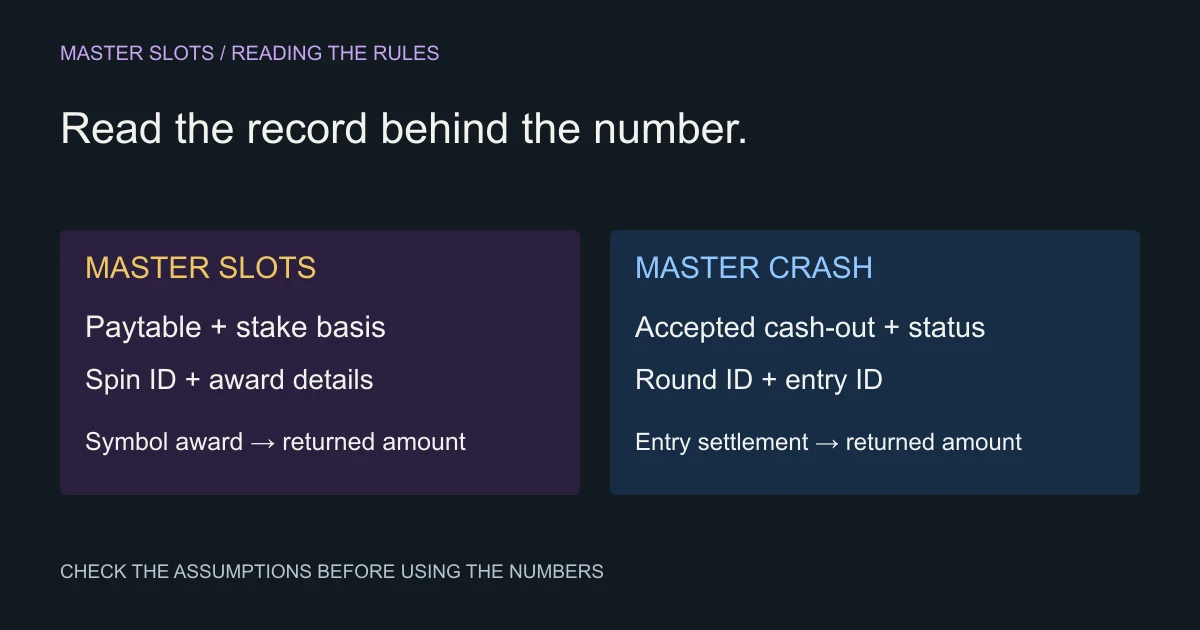
For a complete session, reconcile the wallet and the game records separately. The accounting method can be reused, but a Crash cash-out calculator does not evaluate slot symbols or paylines.
What to keep when the amount does not match
Retain the game title, rules version, spin ID, total stake, active-line configuration, award basis, result breakdown and wallet credit. Mark whether the entry is settled, pending or refunded. Ask support which award basis and combination produced the disputed amount.
The UK Gambling Commission’s RTS 3 is a useful documentation reference: it addresses accessible rules and payout information for products within its scope. It does not establish that Master Slots is licensed there or that its rules have been independently checked.
Once the payout is understood, the next question is how often different awards occur. Read RTP, hit frequency and profitable spins. If you came from a multiplier game, the Slots–Crash comparison explains why a reel award is not a timed cash-out.
Sources & further reading
- Master Games: Master Slots product description (publisher claims)
- Gambling Commission RTS 3: explaining rules and payouts (Great Britain scope)
Worked examples are illustrative. Operator documentation describes that operator’s product and is not an independent audit of the games discussed here.